
Vue du Village d'Herment
1849–50
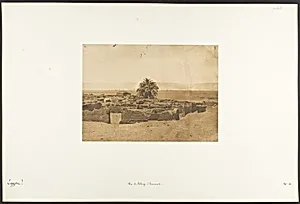
Medium
Salted paper print from paper negative
Dimensions
Image: 6 in. × 8 3/8 in. (15.3 × 21.3 cm) Mount: 12 5/16 × 18 11/16 in. (31.2 × 47.5 cm)
Classification
Photographs
Department
Photographs
Museum
Metropolitan Museum of Art, New York, NY
Credit
Gilman Collection, Gift of The Howard Gilman Foundation, 2005
Accession Number
2005.100.376.86
Rights
Public Domain
Tags
Art Historical Context
**Vue du Village d'Her** captures the serene charm of the French village of Hériment in the Auvergne, as seen through the lens of Maxime Du Camp around 1849–50. Du Camp, a pioneering French and writer best known for his groundbreaking travels to Egypt with Gustave Flaubert, turned his camera toward everyday European landscapes early in his career. This paper print offers a poetic glimpse of rural life—rolling hills, clustered homes, and perhaps a hint of daily activity—evoking the Romantic fascination with nature's quiet beauty. Printed from a paper negative using the calotype process invented by William Henry Fox Talbot, the image exemplifies one of photography's first reproducible methods. Salted paper prints, bathed in a light-sensitive solution of table salt and silver nitrate, yield soft, warm tones with subtle gradations, distinguishing them from the sharper daguerreotypes of the era. At just 6 × 8⅜ inches, this intimate scale invites close contemplation, highlighting photography's potential to document the world with unprecedented fidelity. Acquired through the Gilman Collection at The Metropolitan Museum of Art, this work underscores Du Camp's role in photography's formative years, bridging artistic exploration and scientific innovation. It reminds us how 19th-century lenses preserved vanishing village scenes, preserving cultural heritage for generations. (198 words)
About the Artist
Maxime Du Camp · 1822–present
Maxime Du Camp (1822–1894) was a pioneering French photographer and writer whose adventurous spirit and technical innovation bridged literature and visual art during the mid-19th century. Born in Paris on February 8, 1822, to a prosperous family—his father a successful surgeon—Du Camp received a solid bourgeois education at the Collège Bourbon (now Lycée Condorcet), where he cultivated interests i...