
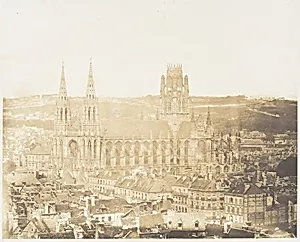
Vue générale de Saint-Ouen
1852–54
Medium
Salted paper print from glass negative
Dimensions
24.8 x 31.1 cm (9 3/4 x 12 1/4 in. )
Classification
Photographs
Department
Photographs
Museum
Metropolitan Museum of Art, New York, NY
Credit
Harris Brisbane Dick Fund, 1995
Accession Number
1995.96.6
Rights
Public Domain
Tags
Art Historical Context
**Vue générale de Saint-Ouen (1852–54) by Edmond Bacot captures a panorama of the magnificent Gothic abbey church of Saintuen in Rouen, France This salted paper print from a glass negative offers visitors a rare glimpse into mid-19th-century urban life, blending the soaring spires of the cathedral with the surrounding cityscape. Bacot, a pioneering French photographer active in Normandy, documented architectural treasures like Saint-Ouen—often called the "Parthenon of France" for its Flamboyant Gothic mastery—preserving them in an era before widespread preservation efforts. The medium is a highlight of early photography's artistry. Salted paper prints, popular in the 1840s–50s, involve coating paper with salt and silver nitrate to create warm-toned, textured images from glass negatives. This calotype-derived process yields subtle gradations ideal for architectural details, though prone to fading, making surviving examples like this 24.8 x 31.1 cm print precious. Acquired via the Harris Brisbane Dick Fund in 1995, it now graces the Metropolitan Museum of Art's Photographs department. Bacot's work reflects photography's revolutionary role in democratizing views of grand cathedrals, once accessible only to travelers. Imagine standing in 1850s Rouen: this image evokes the awe of medieval stone against industrial-age innovation, inviting us to appreciate how early lenses immortalized cultural icons.