
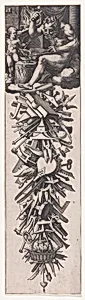
Vulcan Forging the Wings of Cupid
Medium
Engraving; first state of two
Dimensions
sheet: 9 7/8 x 2 9/16 in. (25.1 x 6.5 cm)
Classification
Prints
Department
Drawings and Prints
Museum
Metropolitan Museum of Art, New York, NY
Credit
Purchase, Anne and Carl Stern Gift, 1958
Accession Number
58.627.4(1)
Rights
Public Domain
Art Historical Context
René Boyvin’s engraving *Vulcan Forging the Wings of Cupid* captures a lively moment from classical mythology in which the god of fire and metalworking crafts delicate wings for the young god of love. Created in the mid-sixteenth century, the print reflects the elegant, elongated figures and intricate ornamental detail characteristic of French Mannerism, particularly the style fostered at the royal château of Fontainebleau. Boyvin, a skilled reproductive engraver, translated designs by leading court artists into a medium that could be widely circulated, allowing viewers across Europe to enjoy refined mythological imagery. As an engraving—the first of two states—the work demonstrates the precision and tonal richness possible with the burin. Fine parallel lines and subtle cross-hatching model the muscular forms of Vulcan and the fluttering wings, while the compact vertical format (roughly 25 by 6.5 centimeters) suggests the print may have been intended for a collector’s album or as part of a decorative series. Such prints played an important role in disseminating both artistic ideals and stories from antiquity during the Renaissance. Today in the Metropolitan Museum’s collection, the engraving offers a window into the period’s fascination with mythology reimagined through sophisticated draftsmanship and technical virtuosity.
About the Artist
René Boyvin · 1525–1580
French, Angers ca. 1525–1598 or 1625/6 Angers