
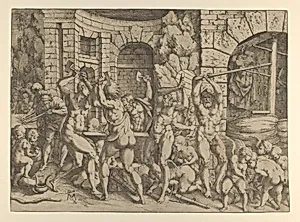
Vulcan's Forge
Medium
Etching
Dimensions
Sheet: 12 1/16 x 16 9/16 in. (30.7 x 42 cm)
Classification
Prints
Department
Drawings and Prints
Museum
Metropolitan Museum of Art, New York, NY
Credit
The Elisha Whittelsey Collection, The Elisha Whittelsey Fund,1955
Accession Number
55.590.5
Rights
Public Domain
Tags
Art Historical Context
Step into the fiery world of mythology with *Vulcan's Forge*, an exquisite etching from around 1542–45, created by an anonymous artist from the School of Fontaineble. This 16th-century French workshop, centered at the opulent Château de Fontainebleau under King Francis I, blended Italian Mannerist elegance with native artistry. Attributed variably to the Master of Story of Cadmus or Francesco Primaticcio—a key figure in the school—the print measures 12 1/16 x 16 9/16 inches and captures the Roman god Vulcan at work amid his cyclopean helpers. The scene buzzes with dynamic energy: Vulcan, god of fire and forge, oversees the crafting of gleaming weapons, evoking epic tales from Ovid's *Metamorphoses*. Etching, a revolutionary intaglio technique popularized in the Renaissance, allowed precise lines and rich tonal effects, making complex compositions like this accessible beyond paintings. Produced during France's cultural Renaissance, it reflects the era's fascination with classical antiquity and royal patronage of the arts. Housed in the Metropolitan Museum of Art's Drawings and Prints department (The Elisha Whittelsey Collection, 1955), this work highlights the School of Fontainebleau's influence on printmaking, disseminating Mannerist motifs—elongated figures, intricate details, and dramatic lighting—across Europe. A testament to artistry's power to immortalize myth, it invites visitors to ponder the blacksmith god's enduring symbol of human ingenuity and divine craft.
About the Artist
Master of the Story of Cadmus|Francesco Primaticcio|Anonymous, French, School of Fontainebleau, 16th century (French|Italian| ) · 1500 |1504 |1540 –1600 |1570 |1547
|Italian, Bologna 1504/5–1570 Paris|active ca. 1542–47