
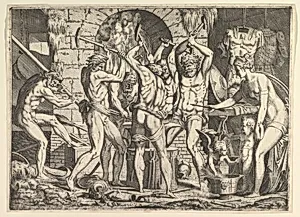
Venus in Vulcan's Forge
1546–47
Medium
Etching
Dimensions
Plate: 12 7/8 × 17 11/16 in. (32.7 × 45 cm) Sheet: 13 1/8 × 18 1/16 in. (33.4 × 45.8 cm)
Classification
Prints
Department
Drawings and Prints
Museum
Metropolitan Museum of Art, New York, NY
Credit
Harris Brisbane Dick Fund, 1932
Accession Number
32.92.3
Rights
Public Domain
Tags
Art Historical Context
In the grand tradition of Renaissance printmaking, *Venus in Vulcan's Forge (1546–47) is an exquisite etching by Léon Davent a design by Luca Penni.ni, a prominent Italian Mannerist painter associated with the School of Fontainebleau, intricate compositions blending classical mythology with elegant, elongated figures characteristic of Mannerism. Davent, a skilled French engraver, masterfully translated this into etching—a relatively new technique at the time, prized for its fluid lines and tonal depth, allowing for subtle shading that mimicked drawing. The scene draws from Ovid's *Metamorphoses*, depicting Venus, goddess of love, amid the fiery workshop of her husband Vulcan, god of fire and forge. Surrounded by cyclopes hammering divine armor, the print captures a moment of divine intimacy and labor, highlighting the tension between beauty and craftsmanship in classical lore. Such mythological subjects were immensely popular in 16th-century Europe, serving as both decoration and moral allegory. This large-scale etching (plate: 12⅞ × 17¹¹⁄₁₆ in.), now in the Metropolitan Museum of Art's Drawings and Prints collection (Harris Brisbane Dick Fund, 1932), exemplifies how prints democratized elite art, spreading Fontainebleau's sophisticated style across courts and workshops. A testament to collaborative artistry, it invites viewers to marvel at the interplay of myth, technique, and human ingenuity.
About the Artist
Léon Davent|Luca Penni · 1540–1556
**Léon Davent** (also known as Master L.D. or the monogrammist L.D.) was a French printmaker active in the mid-16th century, best known for his work in both engraving and etching. He played a leading role in the printmaking workshop associated with the First School of Fontainebleau at the Palace of Fontainebleau during the 1540s. His prints, often signed simply “L.D.,” reproduced designs by Italia...