
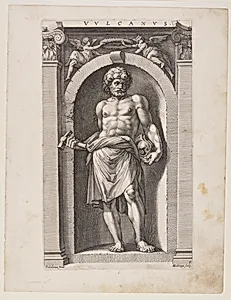
Vulcanus, from Eight Pagan Gods
Medium
Engraving on ivory laid paper
Dimensions
Plate: 35.7 × 21.5 cm (14 1/16 × 8 1/2 in.); sheet: 40.7 × 31.3 cm (16 1/16 × 12 3/8 in.)
Classification
Department
Prints and Drawings
Museum
Art Institute of Chicago
Accession Number
268553
Rights
Public Domain
Art Historical Context
Behold Hendrick Goltzius's *Vulcanus, from Eight Pagan Gods* (1592), a masterful engraving that captures the Roman god of fire and metalworking in a dynamic, muscular. Created during the late Northern Renaissance, this print belongs to a celebrated series of eight engravings depicting pagan deities, drawing on classical mythology to showcase Goltzius's virtuosic skill. As a leading Dutch Mannerist, Goltzius blended Italian influences—like Michelangelo's anatomy—with Northern precision, making gods appear almost superhumanly alive. Engraved on fine ivory laid paper (plate: 35.7 × 21.5 cm), the medium highlights Goltzius's revolutionary technique: deep, swelling lines that mimic the swelling contours of the body, creating a sense of three-dimensional volume and dramatic chiaroscuro. Prints like this were revolutionary, allowing affordable dissemination of high art to collectors across Europe, elevating engraving from craft to fine art. Housed in the Art Institute of Chicago's Prints and Drawings department, *Vulcanus* reflects the era's fascination with antiquity amid religious upheaval, inviting viewers to marvel at divine power forged in ink and copper. A testament to Goltzius's legacy, it remains a highlight for print enthusiasts.
About the Artist
Hendrick Goltzius · 1558–1617
Hendrick Goltzius (1558–1617) was the most celebrated engraver of the Northern Renaissance and a pivotal figure in Dutch Mannerism. Born near the German-Dutch border, Goltzius transformed printmaking into a virtuoso art form through his revolutionary 'swelling line' technique, where the burin was manipulated to create lines of varying thickness that produced unprecedented tonal effects and three-d...