
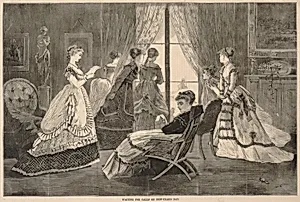
Waiting for Calls on New Year's Day, from Harper's Bazar, January 2, 1869
1869
Medium
Graphic Arts-Print
Classification
Graphic Arts-Print
Department
Smithsonian Collection
Museum
Smithsonian American Art Museum
Credit
Smithsonian American Art Museum, The Ray Austrian Collection, gift of Beatrice L. Austrian, Caryl A. Austrian and James A. Austrian
Accession Number
1996.63.162
Rights
Public Domain
Tags
Art Historical Context
Winslow Homer's *Waiting for Calls on New Day*, published in *Harper's Bazar* January 2, 1869, captures a charming slice of post-Civil War American social. As a leading illustrator for magazines like *Harper's Weekly*, Homerfully depicted everyday scenes with realistic detail and emotional depth, bridging his early wood engraving work to his later iconic paintings. This graphic arts print reflects the era's New Year's tradition, where gentlemen made formal "calling" visits to ladies' homes, a custom rooted in Victorian etiquette that emphasized courtship and community. The image likely portrays a young woman poised in anticipation inside a domestic setting—a house adorned for the holiday—evoking quiet tension and hopeful waiting. Homer's precise line work and shading in this wood engraving highlight textures and subtle expressions, drawing viewers into the intimacy of the moment. Such illustrations were vital in 19th-century periodicals, making art accessible to a broad middle-class audience and preserving cultural rituals amid rapid social change. Housed in the Smithsonian American Art Museum's Ray Austrian Collection, this piece exemplifies Homer's skill in blending humor, realism, and social observation, offering a window into 1860s femininity and festivity. A delightful nod to bygone holidays!
About the Artist
Winslow Homer · 1836–1910
Winslow Homer (1836-1910) was one of America's greatest painters and a preeminent figure in 19th-century American art. Largely self-taught, Homer began his career as a commercial illustrator and Civil War correspondent for Harper's Weekly before becoming renowned for his powerful marine subjects and landscape paintings. His mastery of both oil and watercolor, combined with his uncompromising reali...