
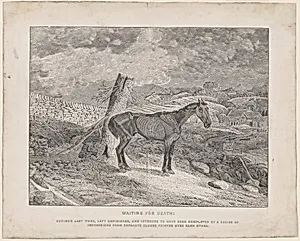
Waiting for Death
1828
Medium
wood engraving
Dimensions
sheet: 29.4 × 36.4 cm (11 9/16 × 14 5/16 in.)
Classification
Department
CG-E
Museum
National Gallery of Art, Washington, D.C.
Credit
Gift of Thomas Vogler in memory of his brother Donald J. Vogler
Accession Number
2017.53.6
Rights
Public Domain
Art Historical Context
**Waiting for Death**, a poignant wood engraving by Thomas Bew from 1828, captures the artist's mastery of a medium he helped elevate to fine art. Created on the eve of Bewick's death at age 75, this 29.4 × 36.4 cm print exemplifies his innovative technique: engraving intricate details into the end-grain of boxwood blocks, allowing for the fine lines and textures that rivaled more expensive copperplate etching. Housed in the National Gallery of Art's Prints department (gift of Thomas Vogler in memory of Donald J. Vogler), it reflects Bewick's lifelong dedication to naturalistic precision. Bewick, a pioneering English engraver from Northumberland, gained fame through illustrated books like his *History of British Birds* (1797–1804), blending scientific observation with storytelling vignettes. Wood engraving's significance lies in its affordability and durability for book printing, democratizing high-quality imagery during the Industrial Revolution. Themes in Bewick's tailpieces often explored rural life, morality, and human frailty—here, the evocative title *Waiting for Death* likely evokes a memento mori meditation on mortality, a common motif in 19th-century art amid rapid social change. This work invites visitors to ponder life's transience through Bewick's subtle, evocative detail, bridging nature's beauty with existential reflection. A testament to his enduring legacy, it reminds us how printmaking preserved stories for generations.
About the Artist
Thomas Bewick · 1753–1828
Thomas Bewick (c. 11 August 1753–8 November 1828) was born at Cherryburn in Mickley, Northumberland, the eldest of eight children to tenant farmers John and Jane Bewick. From a young age, he displayed a natural talent for drawing animals and birds observed in the local countryside, without formal art lessons. At age 14 in 1767, he was apprenticed to metal engraver Ralph Beilby in Newcastle upon Ty...