
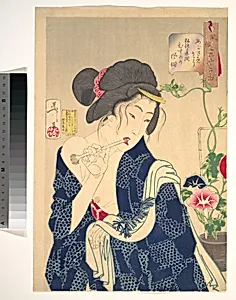
Waking Up: A Girl of the Kōka Era (1844–1848)
Medium
Woodblock print; ink and color on paper
Dimensions
14 5/8 x 10 in. (37.1 x 25.4 cm)
Classification
Prints
Culture & Period
Japan · Meiji period (1868–1912)
Department
Asian Art
Museum
Metropolitan Museum of Art, New York, NY
Credit
Purchase, Friends of Asian Art Gifts, 2005
Accession Number
2005.349
Rights
Public Domain
Tags
Art Historical Context
In the serene woodblock print *Waking Up: A of the Kōka (1844–1848)*, Tsukioka Yoshitoshi captures a moment of intimate vulnerability: a young woman rousing from sleep, her disheveled hair and flowing robes evoking the fleeting beauty of youth. Created in 1888 during Japan's Meiji period (1868–1912), this 14⅝ × 10-inch ink and color print on paper exemplifies ukiyo-e, the "pictures of the floating world" tradition. Yoshitoshi, one of the last great masters of this art form, blends delicate realism with poetic nostalgia, showcasing his signature finesse in rendering fabrics, skin tones, and subtle expressions through layered colors and precise carving. The Kōka era (1844–1848), part of the late Edo period, marked a time of social change just before Japan's forced opening to the West. Yoshitoshi's work reflects Meiji-era fascination with the past, idealizing Edo-period fashions like the girl's elaborate shimada hairstyle and kimono. As a bijin-ga (beautiful women) print, it celebrates feminine grace amid modernization, using woodblock techniques—where artisans carved intricate blocks for vibrant, hand-rubbed pigments—to make art accessible to everyday viewers. Housed in the Metropolitan Museum of Art's Asian Art Department, this piece highlights woodblock prints' cultural role in preserving Japan's aesthetic heritage, inviting us to ponder the timeless allure of quiet mornings.
About the Artist
Tsukioka Yoshitoshi · 1839–1892
Tsukioka Yoshitoshi was born on April 30, 1839, in the Shimbashi district of Edo, the city that would become Tokyo. At the age of eleven he was apprenticed to Utagawa Kuniyoshi, one of the great masters of the Japanese woodblock print, who gave the boy the artist name 'Yoshitoshi' as a mark of lineage within the Utagawa School. From Kuniyoshi, Yoshitoshi absorbed the full tradition of ukiyo-e — th...