
Walchensee landschaft (Walchensee Landscape)
1919
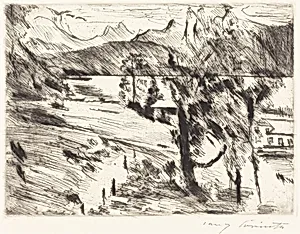
Medium
drypoint in black on wove paper
Dimensions
plate: 22 x 30 cm (8 11/16 x 11 13/16 in.) sheet: 37.6 x 50.8 cm (14 13/16 x 20 in.)
Classification
Department
CG-W
Museum
National Gallery of Art, Washington, D.C.
Credit
Gift of Jacob Kainen
Accession Number
2002.98.269
Rights
Public Domain
Art Historical Context
Lovis Corinth's *Walchensee Landschaft* (1919) captures the dramatic beauty of Germany's Walchensee, a deep Alpine lake in Bavaria, through the intimate medium of drypoint etching on wove paper. Created late in the artist's career, this print measures 22 x 30 cm on the plate, showcasing Corinth's shift toward bold, expressive landscapes after a debilitating stroke in 1911. By 1919, the German Expressionist had retreated to Walchensee, where he produced over 100 works inspired by its rugged peaks and shimmering waters, reflecting a renewed vitality in his post-war output. Drypoint, Corinth's favored printmaking technique, involves scratching directly into a copper plate with a sharp tool, raising a soft burr that yields rich, velvety black lines and textured depths. This method lent his prints a painterly immediacy, bridging his oil paintings' loose brushwork with the precision of intaglio. The result is a vivid evocation of light and atmosphere, where jagged mountains and reflective water merge in dynamic tension. Now housed in the National Gallery of Art's print collection (gift of Jacob Kainen), this work exemplifies Corinth's late mastery, blending Romantic sublime with modernist freedom. Visitors will appreciate its tactile richness, a window into an artist's triumphant embrace of nature amid personal and historical turmoil.
About the Artist
Lovis Corinth · 1858–1925
Lovis Corinth, born Franz Heinrich Louis on July 21, 1858, in Tapiau, East Prussia (now Gvardeysk, Russia), to a tanner father, displayed prodigious drawing talent from childhood. He began formal training at the Königsberg Academy in 1876, then moved to the Academy of Fine Arts in Munich from 1880 to 1884, studying under Ludwig von Löfftz and briefly Franz von Defregger, where he absorbed a Realis...