
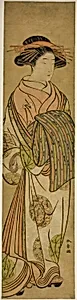
Walking Courtesan, Possibly Sugawara of the Tsuruya House of Pleasure
mid–late 1770s
Medium
Color woodblock print; wide hashira-e
Dimensions
69 × 16.6 cm (27 1/4 × 6 5/8 in.)
Classification
woodblock print
Department
Arts of Asia
Museum
Art Institute of Chicago
Accession Number
21480
Rights
Public Domain
Art Historical Context
Behold the elegant *Walking Courtesan, Possibly Sugawara of Tsuruya House of*, a captivating color woodblock print by Katsukawa Shunsho from the mid–late 0s. Shunsho, a leading figure in Edo-period ukiyo-epictures of the floating world), masterfully captures the grace of a high-ranking courtesan from Yoshiwara, Tokyo's famed pleasure district. The Tsuruya House was a renowned yūkaku establishment, and this beauty—striding confidently in luxurious robes—embodies the era's fascination with bijin-ga, or images of beautiful women, blending allure with poised sophistication. This wide hashira-e, or pillar print (69 × 16.6 cm), is a striking vertical format designed to adorn architectural pillars in homes or teahouses, its narrow dimensions maximizing visual impact in tight spaces. Printed using the intricate woodblock technique—likely nishiki-e with vibrant brocade-like colors—Shunsho's precise lines and subtle shading highlight the courtesan's flowing kimono, intricate hairpins, and subtle expression, showcasing his skill in evoking movement and texture. In the vibrant world of 18th-century Japan, such prints democratized access to Yoshiwara's glamour, reflecting urban leisure culture amid strict social hierarchies. Today, at the Art Institute of Chicago, this work invites us to ponder the fleeting pleasures of the "floating world," a testament to ukiyo-e's enduring artistic legacy.