
Wall Clock
1937
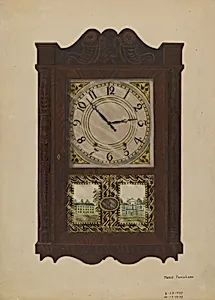
Medium
watercolor, gouache, colored pencil, pen and ink, and graphite on paperboard
Dimensions
overall: 30.5 x 22.8 cm (12 x 9 in.) Original IAD Object: none given
Classification
Index of American Design
Department
CG-W
Museum
National Gallery of Art, Washington, D.C.
Credit
Index of American Design
Accession Number
1943.8.4759
Rights
Public Domain
Art Historical Context
Marie Famularo's *Wall Clock* (1937) is a captivating rendering from the Index of American Design, a WPA Federal Art Project initiative during the Great Depression. Measuring just 12 x 9 inches, this work on paperboard employs a rich array of media—watercolor, gouache colored pencil, pen and, and graphite—to meticulously document an everyday American wall clock. Famularo, one of many artists commissioned for the project, transformed a functional object into a vibrant celebration of vernacular craftsmanship, preserving its form and ornamentation for posterity. The Index of American Design, active from 1935 to 1942, tasked over 200 artists with creating more than 15,000 watercolor renderings of folk art, decorative objects, and industrial designs across the U.S. This effort not only provided jobs for Depression-era artists but also fostered national pride in everyday American aesthetics, from Shaker furniture to Native American crafts. Famularo's piece exemplifies the project's goal: blending artistic skill with historical documentation to highlight regional design traditions. Housed in the National Gallery of Art's collection, *Wall Clock* showcases the layered techniques that bring the object's textures, colors, and details to life—gouache for bold hues, ink for fine lines, and graphite for subtle shading. It's a testament to how art captured the cultural heartbeat of 1930s America, inviting us to appreciate the beauty in the ordinary.
About the Artist
Marie Famularo · 1901–1975
Marie Famularo (1901–1975) was an American artist whose meticulous illustrations played a vital role in preserving the visual legacy of everyday American folk art during the Great Depression era. Active primarily in the 1930s, she contributed to the Index of American Design (IAD), a groundbreaking Works Progress Administration (WPA) Federal Art Project initiative that commissioned artists to docum...