
Wall Pocket for Flowers
c. 1936
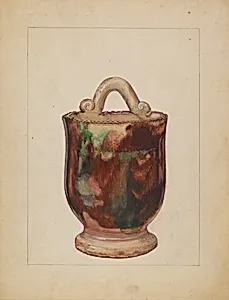
Medium
graphite, watercolor, gouache, colored pencil, andheightening on paperboard
Dimensions
overall: 29.7 x 22.6 cm (11 11/16 x 8 7/8 in.) Original IAD Object: 4 1/2" High 6 3/4" High(overall) 3 3/8" Base
Classification
Index of American Design
Department
CG-W
Museum
National Gallery of Art, Washington, D.C.
Credit
Index of American Design
Accession Number
1943.8.5194
Rights
Public Domain
Art Historical Context
Created around 1936 by artist John Fisk, *Wall Pocket for Flowers* a meticulously rendered depiction of a charming American folk art object—a decorative pocket designed to hold fresh blooms against a wall. Part of the Index of American Design (IAD), a New Deal-era Federal Art Project (19351942), this work captures the essence of everyday American craftsmanship during the Great Depression. The IAD commissioned artists like Fisk to document regional decorative arts through precise, colorful illustrations, preserving cultural heritage at a time when such objects faced neglect or destruction. Fisk employed a rich mixed-media technique on paperboard: graphite for fine outlines, watercolor and gouache for vibrant hues, colored pencil for intricate details, and heightening for luminous accents that mimic the original's glossy surface. Measuring 29.7 x 22.6 cm, the drawing faithfully records the wall pocket's modest scale (original object about 4½ inches high with a 3⅜-inch base), highlighting its whimsical form likely rooted in 19th-century pottery traditions. Housed in the National Gallery of Art's collection, this piece underscores the IAD's role in celebrating vernacular design, bridging utilitarian beauty with national identity. Visitors today can appreciate how such renderings revived interest in America's artistic past, turning humble household items into symbols of enduring creativity.
About the Artist
John Fisk · 1855–present
John Fisk is an artist about whom verified biographical information is limited in the major art historical literature. No confirmed dates of birth or death have been established, and details regarding nationality, training, and primary period of activity remain undocumented in readily available scholarly sources. Works attributed to John Fisk have entered museum collections, suggesting a level of...