
Walnut Spool Cabinet
c. 1938
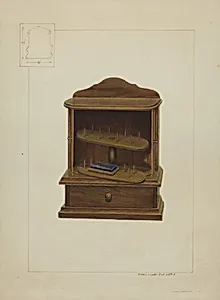
Medium
watercolor, graphite, and pen and ink on paper
Dimensions
overall: 30.2 x 22.1 cm (11 7/8 x 8 11/16 in.)
Classification
Index of American Design
Department
CG-W
Museum
National Gallery of Art, Washington, D.C.
Credit
Index of American Design
Accession Number
1943.8.14837
Rights
Public Domain
Art Historical Context
Step into the meticulous world of American folk art with *Walnut Spool Cabinet*, a captivating rendering Edward L. Loper around 1938. delicate watercolor, graphite, and pen-and-ink drawing on paper (30.2 x 22.1 cm) depicts a finely crafted wooden cabinet designed to store sewing spools, showcasing the elegant simplicity of early American. The walnut's rich grain and precise joinery highlight the utilitarian beauty of household objects from America's decorative arts tradition. Created as part of the Index of American Design—a groundbreaking WPA Federal Art Project (19351942)—Loper's work served to document and celebrate the nation's material culture during the Great Depression. Artists like him produced thousands of such detailed plates, blending photographic accuracy with artistic flourish to preserve everyday treasures before they faded into obscurity. The mixed media technique shines here: graphite and ink outline every dovetail and curve with draftsman-like precision, while watercolor infuses warm tones, evoking the wood's tactile warmth. Housed in the National Gallery of Art's Index of American Design collection, this piece underscores the cultural value of anonymous craftsmanship, reminding us how ordinary tools embodied artistry and ingenuity in American homes. A testament to heritage, it invites you to appreciate the quiet splendor of the everyday.
About the Artist
Edward L. Loper · 1916–2011
Edward Leroy Loper Sr. was born on April 7, 1916, in Wilmington, Delaware, to a poor family in the racially mixed Frogtown neighborhood, where he was raised primarily by his maternal grandmother. After graduating from Howard High School, the only secondary school available to African Americans in Delaware at the time, Loper received no formal artistic training initially but immersed himself in sel...