
Walther 1er; Troisvalets
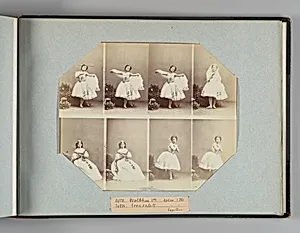
Medium
Albumen silver print from glass negative
Dimensions
Image: 7 3/8 × 9 1/4 in. (18.8 × 23.5 cm) Album page: 10 3/8 × 13 3/4 in. (26.3 × 35 cm)
Classification
Photographs
Department
Photographs
Museum
Metropolitan Museum of Art, New York, NY
Credit
Gilman Collection, Gift of The Howard Gilman Foundation, 2005
Accession Number
2005.100.588.1.146
Rights
Public Domain
Art Historical Context
André-Adolphe-Eugène Disdéri's *Walther 1er; Troisvalets* (1) is a captivating albumen silver print from a glass negative, showcasing the French photographer's mastery during photography's explosive growth in mid-19th-century Europe Disdéri, a Parisian innovator, revolutionized the medium by inventing the *carte de visite* around 1854—a pocket-sized portrait format that made photography accessible to the masses, fueling a collecting craze among the bourgeoisie and aristocracy. This larger image (7 3/8 × 9 1/4 in.), mounted on a 10 3/8 × 13 3/4 in. album page, reflects his commercial versatility beyond standard cartes. The albumen process, coating paper with egg whites sensitized by silver salts, yielded the era's signature warm tones, sharp details, and subtle gradations—ideal for documenting status symbols like thoroughbred horses, hinted at by the evocative title evoking a champion racer ("Walther 1er") and its Troisvalets origins. Produced via glass negative (wet-collodion technique), it captures the Second Empire's equestrian enthusiasm, where such portraits symbolized wealth and leisure. Housed in the Met's Photographs Department as part of the Gilman Collection (2005 gift), this work highlights photography's shift from novelty to cultural staple, blending artistry with precise realism for an age obsessed with image and legacy.
About the Artist
André-Adolphe-Eugène Disdéri · 1819–1889
**André-Adolphe-Eugène Disdéri** (1819–1889) was a pioneering French photographer whose innovations transformed portraiture into a mass medium during the Second Empire. Born on March 28, 1819, in Paris, Disdéri pursued diverse careers in commerce, acting, and politics early on, while studying art amid personal hardships following his father's death, which compelled him to support his mother, sibli...