
Wandtafel met onderblad
1500
Medium
wood (plant material)
Dimensions
69.5; 72; 42
Rights
Public Domain
About this artwork
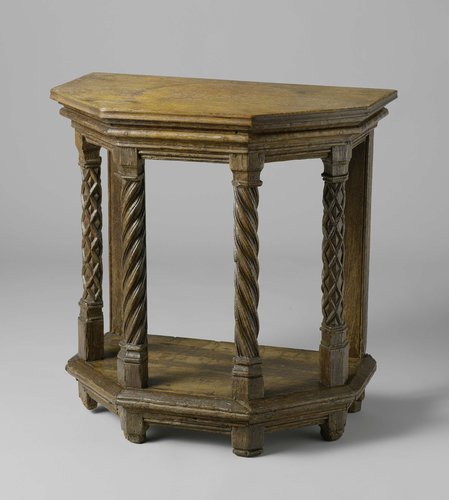
Wandtafel van eikenhout op een grondplan van een halve achthoek. Het blad rust op geprofileerde lijsten op zes stijlen, onderaan door een blad met eveneens geprofileerde lijsten verbonden. De achterste stijlen zijn vlak met eenvoudige profilering, de vier overige zijn behandeld als zuiltjes met kapitelen en basementen op door het onderblad heengaande voetstukken. De schachten van de twee voorstijlen hebben rondom gestoken, geruit vlechtbandwerk.Het bovenblad is modern, het onderblad is later aan...
Art Historical Context
### Wandtafel met onderbladWall Table with Under-shelf), ca. 1500 This anonymous oak wood wall table, dating to around 1500, exemplifies late Gothic furniture craftsmanship from Northern Europe, likely the Low where such pieces adorned affluent homes. Its innovative half-octagonal base allowed it to hug a wall snugly, maximizing space in period interiors. Crafted from durable oak—a favored material for its strength and workability—the table features a top resting on profiled frames supported by six sturdy legs. The rear pair is simply profiled for practicality, while the four front legs are elegantly turned into miniature columns, complete with capitals, bases, and footpieces that extend through the lower shelf. The two foremost legs boast intricate, all-around carved diamond-patterned plaitwork, showcasing the carver's skill in low-relief decoration. Though the top shelf is a modern replacement and the under-shelf a later addition—common adaptations for centuries-old furniture—this piece highlights evolving domestic design. Its architectural motifs, like columned supports, bridge Gothic ornateness with emerging Renaissance classicism, reflecting a time when furniture began emphasizing both form and subtle symbolism. Standing at 72 cm high, 69.5 cm wide, and 42 cm deep, it invites visitors to imagine it laden with silverware or linens in a 16th-century hall, a testament to everyday artistry.
About the Artist
anonymous
In the vast tapestry of art history, "Anonymous" stands not as a singular individual but as a collective designation for countless unidentified creators whose works have endured across millennia. These artists, spanning prehistoric cave painters to medieval illuminators and folk craftsmen, produced the foundational layers of human visual culture. Prior to the Renaissance, when individual fame emer...