
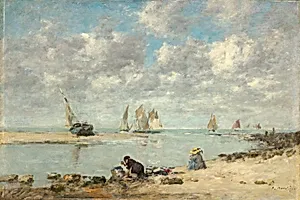
Washerwoman near Trouville
c. 1872/1876
Medium
oil on wood
Dimensions
overall: 27.6 × 41.3 cm (10 7/8 × 16 1/4 in.) framed: 46.04 × 60.64 × 8.26 cm (18 1/8 × 23 7/8 × 3 1/4 in.)
Classification
Painting
Department
CF
Museum
National Gallery of Art, Washington, D.C.
Credit
Collection of Mr. and Mrs. Paul Mellon
Accession Number
1983.1.15
Rights
Public Domain
Art Historical Context
Eugène Boudin's *Washerwoman near Trouville* (c. 1872/1876) captures a serene moment of everyday life along the Normandy coast, a region the artist cherished. Trouville, a bustling seaside resort, frequently inspired Boudin's plein-air sketches, where he depicted beachgoers, fishermen, and laborers under shifting skies. As a pivotal precursor to Impressionism, Boudin emphasized fleeting atmospheric effects—soft light, sea breezes, and subtle color harmonies—foreshadowing the works of his pupil Claude Monet. Painted in oil on a compact wood panel (27.6 × 41.3 cm), this intimate format was ideal for outdoor work, allowing Boudin to paint directly from nature with loose, vibrant brushstrokes. The medium's portability suited his nomadic style, blending realism with impressionistic freedom to evoke transience. The washerwoman, bent over her laundry by the shore, symbolizes the humble rhythms of coastal labor amid bourgeois leisure. Housed in the National Gallery of Art as part of the Paul Mellon Collection, this gem highlights Boudin's role in bridging Romanticism and modern landscape painting, inviting viewers to savor the poetry in ordinary scenes.
About the Artist
Eugène Boudin · 1824–1898
Eugène Louis Boudin was born on July 12, 1824, in Honfleur, Normandy, the son of a harbor pilot. When his family relocated to Le Havre, his father opened a stationery and picture-framing shop, and it was there that the young Boudin first encountered working artists. Artists such as Constant Troyon and Jean-François Millet recognized his talent and urged him toward a career in art. In 1850, a munic...