
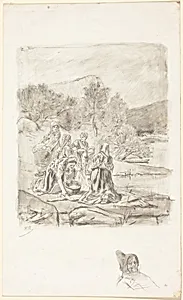
Washerwomen
c.1884-1887
Medium
etching [counterproof] reworked with pen and black ink, black and white chalk, and gray wash
Dimensions
sheet: 34.8 x 21 cm (13 11/16 x 8 1/4 in.)
Classification
Department
CG-E
Museum
National Gallery of Art, Washington, D.C.
Credit
Joseph F. McCrindle Collection
Accession Number
2009.70.202
Rights
Public Domain
Art Historical Context
Félicien Rops (1833–1898), a Belgian artist and leading figure in the Symbolist movement, was renowned for his provocative etchings that blended satire, eroticism, and social commentary during the fin-de-siècle era. Created around 1884–1887, *Washerwomen* exemplifiesops' fascination with everyday scenes infused with subtle sensuality and psychological depth. Working in Paris and Brussels amid the decadent art circles influenced by Baudelaire and the avant-garde, Rops often elevated mundane labor—here, women at their wash—to reveal underlying tensions of modern life. This intricate print began as an etching counterproof, a technique where a fresh proof is pressed against an inked impression to create a reversed mirror image, ideal for artists to study and refine compositions without damaging the original plate. Rops then masterfully reworked it with pen and black ink for precise lines, black and white chalk for tonal modeling, and gray wash for atmospheric depth, resulting in a richly textured sheet measuring 34.8 x 21 cm. Such mixed-media experimentation highlights his innovative printmaking, bridging traditional etching with drawing-like freedom. Housed in the National Gallery of Art's Joseph F. McCrindle Collection, *Washerwomen* invites visitors to appreciate Rops' technical virtuosity and his era's shifting views on gender, labor, and desire— a captivating glimpse into 19th-century artistic rebellion.
About the Artist
Félicien Rops · 1833–1898
Félicien Rops, born Félicien Victor Joseph Rops on July 7, 1833, in Namur, Belgium, to a prosperous textile manufacturing family, displayed prodigious artistic talent from youth. The only child of Nicholas Rops and Sophie Maubile, he received private tutoring until age ten, followed by education at a Jesuit school in Namur (1843–1848), the Athénée Royal de Namur, and the Academy of Fine Arts there...