
Watching Cattle
1888
Medium
Bronze, struck, silvered
Dimensions
2 1/2 × 3 5/16 in. (64 × 84 mm)
Classification
Medals and Plaquettes
Culture
French
Department
European Sculpture and Decorative Arts
Museum
Metropolitan Museum of Art, New York, NY
Credit
Gift of Samuel P. Avery, 1897
Accession Number
97.15.14
Rights
Public Domain
Tags
Art Historical Context
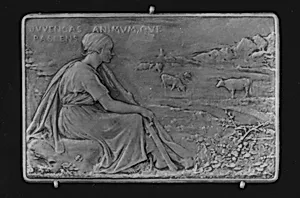
In the tranquil scene of *Watching Cattle* (1888), French artist Louis-Oscar Roty captures serene pastoral moment: a woman gazing thoughtfully at grazing cows. Crafted as a struck bronze plaquette with silvering, this intimate medal measures just 2½ × 3⅜ inches, exemplifying the exquisite miniature sculptures popular in late 19th-century Europe The silvered surface lends a luminous, almost ethereal quality to the relief, highlighting Roty's mastery of fine detail in capturing textures—from the woman's flowing drapery to the cows' soft hides. Roty (1842–1911), a leading figure in the French medal revival, blended Realism's precision with emerging Art Nouveau elegance. Medals like this were prized as collector's items, often celebrating everyday rural life amid France's Industrial Age urbanization. Struck in bronze and selectively silvered, the piece showcases advanced minting techniques that allowed for high-relief modeling in small formats, making it both a sculptural gem and portable art. Gifted to the Metropolitan Museum of Art in 1897 by Samuel P. Avery, *Watching Cattle* reflects the era's fascination with idyllic countryside vignettes, evoking nostalgia for simpler times. Visitors will appreciate its poetic charm, a testament to Roty's enduring influence on decorative arts.
About the Artist
Louis-Oscar Roty · 1846–1911
Louis-Oscar Roty, commonly known as Oscar Roty (1846–1911), was born on June 11 in Paris's Belleville neighborhood, the son of a modest schoolmaster. He began his artistic training under Horace Lecoq de Boisbaudran at the Petite École (later the École des Arts Décoratifs), honing his drawing skills, before entering the École des Beaux-Arts in 1864. There, he studied sculpture and medal engraving u...