
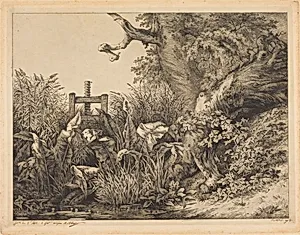
Water Dock and Brambles at a Sluice
1843
Medium
etching [proof] on chine on wove paper
Dimensions
plate: 39 x 50.6 cm (15 3/8 x 19 15/16 in.) sheet: 50.2 x 63.8 cm (19 3/4 x 25 1/8 in.)
Classification
Department
CG-E
Museum
National Gallery of Art, Washington, D.C.
Credit
Gift of Ruth Fine and Larry Day in memory of Frances Smyth
Accession Number
2000.102.1
Rights
Public Domain
Art Historical Context
Eugène Bléry'sWater Dock and Brambles a Sluice* (1843) invites viewers into a lush, untamed corner of the French countryside. This intimate etching captures the tangled beauty of water dock plants and thorny brambles framing a rustic sluice—a simple water gate that hints at rural life along a waterway. Bléry (1802–1887), a masterful French printmaker, was renowned for his meticulous depictions of nature, blending Romantic reverence for the wild with precise observation, bridging the gap toward later realist traditions. Rendered as a proof impression, this work showcases the artistry of etching, where acid bites into a metal plate to create delicate lines and textures. Printed on thin chine collé (Chinese paper) laid onto sturdy wove support, it allowed Bléry to achieve extraordinary detail in foliage and reflections, with the proof state revealing subtle refinements before final publication. Measuring nearly 40 x 51 cm on the plate, its scale draws us close to the scene's quiet drama. Housed in the National Gallery of Art's print collection (gift of Ruth Fine and Larry Day in memory of Frances Smyth), this piece highlights 19th-century etching's role in democratizing fine art. Bléry's work celebrates nature's humble details, offering a timeless meditation on the everyday sublime.
About the Artist
Eugène Bléry · 1805–1887
Eugène Bléry (1805–1887) was a French engraver and etcher whose refined printmaking brought him considerable recognition among connoisseurs of the graphic arts during the nineteenth century. He trained in Paris and developed a particular affinity for landscape subjects rendered through the demanding medium of etching, where his technical precision and sensitivity to natural light set his work apar...