
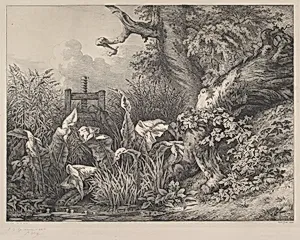
Water Dock and Brambles at a Sluice
1843
Medium
etching [proof] on chine collé
Dimensions
plate: 39 x 50.2 cm (15 3/8 x 19 3/4 in.) sheet: 45.2 x 59.1 cm (17 13/16 x 23 1/4 in.)
Classification
Department
CG-E
Museum
National Gallery of Art, Washington, D.C.
Credit
Ailsa Mellon Bruce Fund
Accession Number
2012.59.3
Rights
Public Domain
Art Historical Context
In the serene etching *Water Dock and Brambles a Sluice* (1843), French artist Eugène Bléry the quiet beauty of a rural waterway scene. Bléry, a master etcher active in mid-19th-century France renders lush water dock plants and tangled brambles framing a sluice—a wooden gate controlling water flow—with meticulous detail. This work reflects the Romantic interest in nature's untamed vitality, evoking the damp, earthy atmosphere of the French countryside during an era of industrialization. Printed as a proof on *chine collé*—a technique where delicate Chinese paper is glued to a sturdier support for enhanced subtlety—Bléry's etching showcases the medium's precision. Etching allowed for fine lines and tonal gradations, ideal for conveying foliage textures and reflective water. At 39 x 50.2 cm, the plate size emphasizes immersive landscape detail, a hallmark of Bléry's contributions to France's etching revival. Acquired through the Ailsa Mellon Bruce Fund for the National Gallery of Art's print collection, this proof highlights Bléry's skill in transforming everyday scenes into poetic studies. Visitors will appreciate its invitation to linger on nature's intricate harmony, bridging art and environment in the 1840s.
About the Artist
Eugène Bléry · 1805–1887
Eugène Bléry (1805–1887) was a French engraver and etcher whose refined printmaking brought him considerable recognition among connoisseurs of the graphic arts during the nineteenth century. He trained in Paris and developed a particular affinity for landscape subjects rendered through the demanding medium of etching, where his technical precision and sensitivity to natural light set his work apar...