
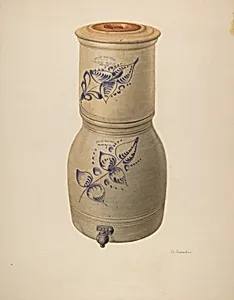
Water Filter and Cooler
c. 1938
Medium
watercolor, colored pencil, and graphite on paperboard
Dimensions
overall: 51.2 x 39.8 cm (20 3/16 x 15 11/16 in.) Original IAD Object: 26 7/8"H Lower:14 7/8H 11Dia.(base) Upper:10 3/4"H 10 3/4Dia.(top)
Classification
Index of American Design
Department
CG-W
Museum
National Gallery of Art, Washington, D.C.
Credit
Index of American Design
Accession Number
1943.8.5080
Rights
Public Domain
Art Historical Context
**Water Filter and Cooler** (c. 1938) is a meticulous rendering by artist Nicholas Amantea, capturing the form and function of an everyday American household object. Created using watercolor, colored pencil, and graphite on paperboard (51.2 x 39.8 cm), this work vividly depicts a two-part ceramic vessel: a lower base (14 7/8 inches high, 11-inch diameter) supporting an upper filter chamber (10 3/4 inches high and wide). Such devices were essential in pre-refrigeration homes, purifying and cooling water through gravity-fed evaporation—a clever nod to practical ingenuity in early 20th-century America. This artwork belongs to the **Index of American Design**, a Federal Art Project under the Works Progress Administration (WPA) during the Great Depression. From 1935 to 1942, artists like Amantea produced over 18,000 precise illustrations of folk art, crafts, and design objects, preserving cultural heritage amid economic hardship. The Index celebrated anonymous makers and regional traditions, highlighting how utilitarian items embodied American resourcefulness. Amantea's technique shines in the layered media, blending soft watercolor washes for porcelain glazes, precise colored pencil for subtle shading, and graphite for sharp contours. Housed in the National Gallery of Art's collection, this piece invites visitors to appreciate the artistry in the ordinary, bridging design history with Depression-era patriotism.
About the Artist
Nicholas Amantea · 1900–1978
Nicholas Amantea (1900–1978) was an American artist born on July 13, 1900, in Pittsburgh, Pennsylvania. His early life and artistic training are not well documented, but by the mid-1930s, he had established himself in New York City, where he contributed significantly to federal art initiatives during the Great Depression. From March 13, 1936, to July 15, 1942, Amantea worked for the Works Progress...