
Water Jug
c. 1938
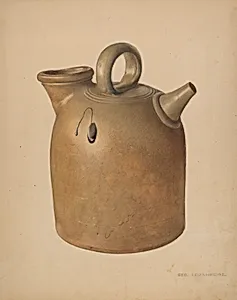
Medium
watercolor, colored pencil, and graphite on paperboard
Dimensions
overall: 41.8 x 33.5 cm (16 7/16 x 13 3/16 in.) Original IAD Object: 11" High
Classification
Index of American Design
Department
CG-W
Museum
National Gallery of Art, Washington, D.C.
Credit
Index of American Design
Accession Number
1943.8.5113
Rights
Public Domain
Art Historical Context
George Loughridge's *Water Jug* (c. 1938) is a meticulously rendered depiction of a traditional American ceramic vessel, captured in watercolor, colored pencil, and graphite onboard. Measuring 41.8 x 33.5 cm, this work faithfully reproduces the jug's simple, functional form—originally about 11 inches high—ing its smooth contours, subtle glazing, and everyday utility. Loughridge's precise lines and soft shading bring out the object's tactile qualities, evoking the humble craftsmanship of early American pottery. Created as part of the Index of American Design, a groundbreaking Federal Art Project under the Works Progress Administration (WPA) during the Great Depression, this piece belongs to a vast archive of over 18,000 watercolor renderings. Launched in 1935, the IAD aimed to document and celebrate America's folk art and design heritage, from quilts to furniture, preserving cultural artifacts at risk of being lost. Housed in the National Gallery of Art's collection, it underscores the era's commitment to artistic employment and national identity. Loughridge's mixed-media technique—blending fluid watercolors for depth, colored pencils for fine details, and graphite for crisp outlines—allowed for hyper-realistic accuracy, making the jug leap off the page as if ready for use. This artwork not only showcases regional pottery traditions but also invites us to appreciate the beauty in utilitarian objects, bridging art history with everyday American life.
About the Artist
George Loughridge · 1855–present
George Loughridge was an American artist active during the 1930s, best known for his contributions to the Index of American Design, a Federal Art Project under the Works Progress Administration (WPA). This ambitious New Deal initiative, running from 1935 to 1943, commissioned hundreds of artists across the United States to create meticulously detailed watercolor renderings of everyday American fol...