
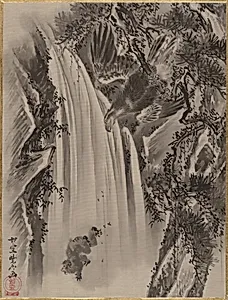
Waterfall, Eagle and Monkey
ca. 1887
Medium
Album leaf; ink and color on silk
Dimensions
14 1/4 x 10 3/4 in. (36.2 x 27.3 cm)
Classification
Paintings
Culture & Period
Japan · Meiji period (1868–1912)
Department
Asian Art
Museum
Metropolitan Museum of Art, New York, NY
Credit
Charles Stewart Smith Collection, Gift of Mrs. Charles Stewart Smith, Charles Stewart Smith Jr., and Howard Caswell Smith, in memory of Charles Stewart Smith, 1914
Accession Number
14.76.61.13
Rights
Public Domain
Tags
Art Historical Context
In the late Meiji period (1868–1912), as Japan rapidly modernized under Western influences, artist Kawanabe Kyōsai bridged traditional Japanese painting with bold, satirical flair. This album leaf, *Waterfall, Eagle and Monkey* (ca. 1887), captures his signature eccentric style—dynamic, humorous, and infused with whimsy. Kyōsai, often called the "last great ukiyo-e master," delighted in anthropomorphic animals and exaggerated forms, drawing from Edo-period traditions while poking fun at societal changes. Rendered in vibrant ink and color on silk, the intimate 14¼ × 10¾-inch format suits an album leaf, a format prized for private contemplation among collectors. The cascading waterfall evokes nature's raw power, juxtaposed with a majestic eagle and playful monkey, symbols of strength and mischief in Japanese lore. Kyōsai's fluid brushwork and vivid pigments create a sense of movement, blending realism with fantasy in a technique honed from his training in Kano-school painting and woodblock prints. Housed in The Metropolitan Museum of Art's Asian Art collection, this work exemplifies Meiji-era innovation: a tiny silk canvas bursting with energy, inviting viewers to ponder harmony amid chaos. Kyōsai's irreverent spirit shines, making it a delightful window into Japan's cultural transition.
About the Artist
Kawanabe Kyōsai 河鍋暁斎 (Japanese) · 1831 –1889
Japanese, 1831–1889