
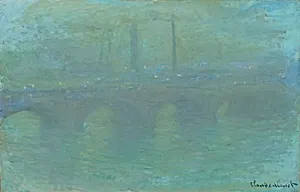
Waterloo Bridge, London, at Dusk
1904
Medium
oil on canvas
Dimensions
overall: 65.7 × 101.6 cm (25 7/8 × 40 in.) framed: 84.46 × 120.02 × 9.53 cm (33 1/4 × 47 1/4 × 3 3/4 in.)
Classification
Painting
Department
CF
Museum
National Gallery of Art, Washington, D.C.
Credit
Collection of Mr. and Mrs. Paul Mellon
Accession Number
1983.1.27
Rights
Public Domain
Art Historical Context
Claude Monet's *Waterloo Bridge, London, at Dusk* (1904) captures the hazy magic of London's Thames River during one of the French master's later visits to England. From his room at the Savoy Hotel, Monet obsessively painted this iconic bridge over a dozen times between 1900 and 1904, chasing the fleeting effects of light through the city's infamous fog. This oil on canvas, measuring 65.7 × 101.6 cm, exemplifies his Impressionist fascination with atmospheric conditions, transforming an industrial landmark into a dreamlike silhouette against a glowing sunset. Monet's loose, vibrant brushstrokes dissolve forms into shimmering color—oranges, purples, and blues blending to evoke the bridge's dusky glow rather than its precise architecture. As a cornerstone of Impressionism, the work prioritizes sensation over detail, influencing modern perceptions of urban landscapes. Part of the National Gallery of Art's collection, gifted by Mr. and Mrs. Paul Mellon, it highlights Monet's enduring quest to paint "the instant," bridging 19th-century Paris with early 20th-century modernity. Visitors will appreciate how this piece immerses you in Monet's sensory world, where London's grit becomes poetry on canvas.
About the Artist
Claude Monet · 1840–1926
Claude Monet, born Oscar-Claude Monet on November 14, 1840, in Paris and raised in Le Havre, Normandy, began his artistic journey as a successful teenage caricaturist. His formal training started at the Le Havre secondary school of the arts in 1851, where he received his first drawing lessons from Jacques-François Ochard. Around 1858, he met Eugène Boudin, who became his pivotal mentor, introducin...