
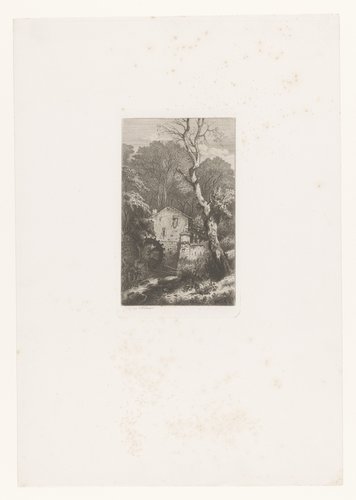
Watermolen in een bos
1833 - 1879
Medium
etching
Dimensions
119; 200
Rights
Public Domain
About this artwork
plaatrand: hoogte 200 mm x breedte 119 mm
Art Historical Context
**Watermolen in een bos** (*Watermill in a Forest*), an etching by Belgian artist Auguste Numans (1833–1879), invites viewers into a tranquil woodland scene centered on a rustic watermill. Created in the 19th century, this modest print—measuring 200 mm high by 119 mm wide—exemplifies the era's fascination with nature's quiet beauty, evoking the Romantic spirit through its depiction of natural elements like flowing water and dense foliage. Numans, known for his landscape etchings, employs this intricate printmaking technique, where acid bites into a metal plate to create fine lines and rich textures. The small plate size (plaatrand: hoogte 200 mm × breedte 119 mm) suggests it was designed for intimate appreciation, perhaps in collectors' albums or portfolios, a common format for 19th-century graphic art. Etching allowed artists like Numans to achieve subtle tonal gradients, bringing depth to the forest's shadows and the mill's weathered stones. This work reflects the enduring Dutch and Flemish tradition of celebrating vernacular architecture amid nature, offering a window into rural life during Belgium's industrializing age. A gem for print enthusiasts, it highlights etching's role in democratizing art through affordable reproductions.
About the Artist
Auguste Numans · 1822–1901
Auguste Numans (1822–1901) was a Belgian painter, draftsman, and printmaker whose career spanned the full breadth of Belgium's cultural golden age in the 19th century. Born on April 22, 1823, in Brussels (though some historical records suggest Antwerp), and dying on October 16, 1901, in Brussels, Numans worked during a period when Belgian art achieved international recognition through figures like...