
Medium
Classification
Department
Smithsonian Collection
Museum
Smithsonian American Art Museum
Credit
National Portrait Gallery, Smithsonian Institution; gift of Mr. and Mrs. Paul Mellon
Accession Number
S/NPG.74.39.5.21
Rights
Public Domain
Tags
Art Historical Context
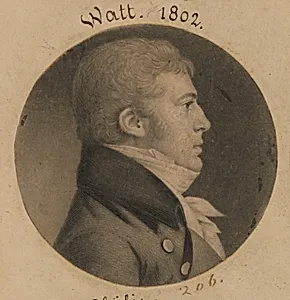
**Watt** (1802) is a striking profile portrait print by Charles Bazar Julien Févret Saint-Mémin, a French artist and engraver who fled the Revolution and settled in Philadelphia in 1793. Saint-Mémin specialized in intimate, precise likenesses of prominent figures, often using a mechanical tracing device called the physiognotrace to capture with scientific accuracy before engraving them onto copper plates. This technique produced affordable, reproducible prints that democratized portraiture in early America, blending Enlightenment precision with neoclassical elegance. Depicting the male subject "Watt"—likely referencing the renowned Scottish inventor James Watt, whose steam engine revolutionized industry—this work dates to 1802, a pivotal time when transatlantic exchanges fueled American innovation and identity. Housed in the Smithsonian American Art Museum's collection, thanks to the generosity of Mr. and Mrs. Paul Mellon, it exemplifies Saint-Mémin's prolific output of over 800 portraits documenting the era's leaders, merchants, and intellectuals. As a testament to portrait printmaking's cultural role, **Watt** highlights how such works preserved legacies and bridged Europe and the young United States, offering visitors a window into the faces shaping a new nation.