
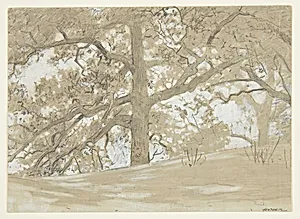
Waverly Oaks
Medium
landscapes
Classification
landscapes
Department
Smithsonian Collection
Museum
Smithsonian American Art Museum
Credit
Gift of Charles Savage Homer, Jr.
Accession Number
1912-12-87
Rights
Public Domain
About this artwork
Research in Progress
Art Historical Context
Winslow Homer's *Waverly Oaks* (1878), now housed in the Smithsonian American Art Museum's Smithsonian Collection, captures the essence of late 19th-century American landscapes. Gifted by Charles Savage Homer, Jr.—likely a family member—this painting reflects Homer's (1836–1910) mastery as a realist artist who bridged the romantic Hudson River School traditions with a more direct, unidealized view of nature. Painted during a pivotal period in Homer's career, when he increasingly turned to outdoor scenes after his Civil War illustrations and early genre works, it showcases his shift toward celebrating the untamed American wilderness. Classified and medium-listed as a landscape, *Waverly Oaks* embodies Homer's technique of bold brushwork and keen observation, emphasizing dramatic light, textured foliage, and expansive skies to evoke the rugged beauty of New England's oak groves. Though research into this piece is ongoing, its significance lies in Homer's influence on American art, inspiring generations to value realism over sentimentality. A must-see for visitors exploring how 19th-century painters documented a rapidly changing nation. (178 words)