
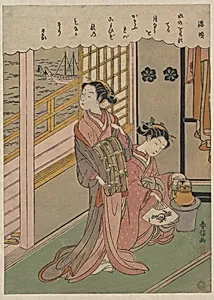
Waves on Moonlight
ca. 1768
Medium
Woodblock print; ink and color on paper
Dimensions
H. 11 in. (27.9 cm); W. 8 in. (20.3 cm)
Classification
Prints
Culture & Period
Japan · Edo period (1615–1868)
Department
Asian Art
Museum
Metropolitan Museum of Art, New York, NY
Credit
Gift of Estate of Samuel Isham, 1914
Accession Number
JP872
Rights
Public Domain
Tags
Art Historical Context
Suzuki Harunobu's *Waves on Moon* (ca. 1768 is a captivating woodblock print Japan's Edo period (161–1868), a when ukiyo-e—"pictures the floating world"—capt the vibrant urban pleasures of Edo (modern). Harunobu, pioneering artist, revolutionized printmaking 1765 by introducing-color *nishiki-e (brocade pictures), using woodblocks to layer vibrant for unprecedented depth and nuance. intimate print, measuring just 11 8 inches, likely elegant women with fans and kett in a moonlit scene evoking gentle waves, domestic grace with poetic nature. The's significance lies in its collaborative craft: Harobu designed the composition, specialized carvers and printers brought his vision to life on paper, enabling affordable art for a wide audience beyond elites. Techniques like *bokashi* (color gradation) create the shimmering moonlight and fluid waves, showcasing Harunobu's mastery of tones and delicate figures. Culturally, such prints celebrated *bijin-ga* (beautiful women) amid everyday motifs, reflecting Edo society's fascination with beauty, leisure, and fleeting moments. Today, this gift to the Metropolitan Museum of Art offers a window into 18th-century Japan's artistic innovation, where printmaking democratized high art.
About the Artist
Suzuki Harunobu · 1725–1770
Suzuki Harunobu (c. 1725-1770) was a Japanese ukiyo-e artist who revolutionized woodblock printing by developing nishiki-e—full-color prints using multiple woodblocks—in 1765. Before Harunobu, Japanese prints were limited to two or three colors; his innovation unleashed the entire artist's palette, transforming ukiyo-e into the vibrant art form that would later captivate Western artists from Manet...