
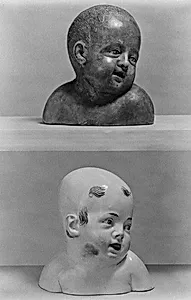
Wax model for the bust of a child
ca. 1715
Medium
Wax
Dimensions
5 3/4 × 5 1/2 in. (14.6 × 14 cm)
Classification
Ceramics-Porcelain
Culture
German, Meissen
Department
European Sculpture and Decorative Arts
Museum
Metropolitan Museum of Art, New York, NY
Credit
Gift of Irwin Untermyer, 1964
Accession Number
64.101.108
Rights
Public Domain
Tags
Art Historical Context
This delicate wax model, created around 1715 by the pioneering Meissen Manufactory represents a child's bust and served as a crucial preparatory step in the production of porcelain figures. Measuring just 5¾ × 5½ inches, its intimate scale captures the tender features of an infant's face, highlighting the manufactory's early mastery in modeling naturalistic expressions. Meissen, established in 1710 in Germany, was Europe's first to successfully produce hard-paste porcelain revolutionizing decorative arts by rivaling Chinese imports. Wax models like this one were essential prototypes, allowing sculptors to refine details before casting molds for firing in kilns—a technically demanding process given porcelain's fragility. This piece exemplifies the transition from wax to ceramic, showcasing the blend of sculptural precision and innovative chemistry that defined Meissen's output. Often depicting cherubic children, such busts reflected Rococo-era fascination with innocence and playfulness. Today, housed in the Metropolitan Museum of Art as a gift from Irwin Untermyer in 1964, it offers a rare glimpse into the behind-the-scenes artistry of one of Europe's greatest porcelain centers, bridging craft and fine art.
About the Artist
Meissen Manufactory · 1710–present
The Meissen Manufactory, established on June 6, 1710, by Augustus the Strong, Elector of Saxony and King of Poland, marked the dawn of true hard-paste porcelain production in Europe. Nestled at Albrechtsburg Castle in Meissen near Dresden, the Royal Polish and Electoral Saxon Porcelain Manufactory arose from alchemical experiments begun in 1708 by physicist Ehrenfried Walther von Tschirnhaus and p...