
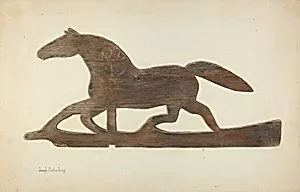
Weather Vane
c. 1938
Medium
watercolor and graphite on paper
Dimensions
overall: 36.6 x 56.8 cm (14 7/16 x 22 3/8 in.) Original IAD Object: 34 1/8" long; 16" high
Classification
Index of American Design
Department
CG-W
Museum
National Gallery of Art, Washington, D.C.
Credit
Index of American Design
Accession Number
1943.8.16312
Rights
Public Domain
Art Historical Context
Behold the intricate *Weather Vane* (c. 1938), a captivating watercolor and graphite rendering by artist Joseph Rothenberg. This detailed depiction captures an original American folk art object measuring 34 1/8 inches long and 16 inches high, showcasing the whimsical craftsmanship typical of early American decorative weathervanes. These functional sculptures, often perched atop barns and steeples, pointed the way with the wind while celebrating local lore through animal or figure motifs. Created as part of the Index of American Design (IAD), a Federal Art Project under the Works Progress Administration (WPA) from 1935 to 1942, Rothenberg's work exemplifies the program's mission to document and preserve the nation's folk art heritage. Artists like him produced over 15,000 precise, colorful renderings of everyday objects, blending artistic skill with historical accuracy to safeguard vanishing traditions amid the Great Depression. Rothenberg's masterful use of watercolor for vibrant hues and graphite for fine lines renders the vane's textures and forms with lifelike clarity, measuring 36.6 x 56.8 cm overall. Housed in the National Gallery of Art, this piece highlights the cultural significance of American folk art, reminding us how humble objects embodied ingenuity and regional pride.
About the Artist
Joseph Rothenberg · 1855–present
Joseph Rothenberg is an artist whose biographical details are not firmly established in major art-historical reference sources. No confirmed dates or nationality have been documented, and the circumstances of his training and career remain obscure in the scholarly record. His name appears in museum and collection contexts in connection with a body of artistic work, indicating recognition within so...