
Weekly Calendar
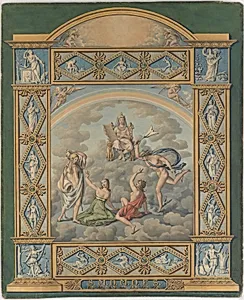
Medium
Pen and black ink, watercolor
Dimensions
ca. 16 15/16 x 13 3/4 in. (43 x 35 cm)
Classification
Drawings
Department
Drawings and Prints
Museum
Metropolitan Museum of Art, New York, NY
Credit
Karen B. Cohen Fund, 2008
Accession Number
2008.474
Rights
Public Domain
Tags
Art Historical Context
Joseph Anton Koch's *Weekly Calendar* (1822) is a captivating drawing that blends classical mythology with everyday timekeeping, featuring lively depictions of lions, male and female nudes, and motifs. Created during Koch's mature period in Rome, where he was a key figure in the Nazarene movement group of German artists seeking to revive the purity and spirituality of Italian Renaissance art—this work exemplifies his skill in fusing symbolic narrative with precise draftsmanship. The composition likely personifies the seven days of the week through allegorical figures, evoking ancient traditions where planets, gods, and zodiac signs like the lion governed time. Executed in pen and black ink with watercolor on paper (ca. 16 15/16 x 13 3/4 in.), the piece highlights Koch's mastery of line work for dynamic contours and watercolor washes for subtle tonal depth. This mixed media allowed for both intricate details in the nude forms—celebrating the Romantic ideal of the human body—and vibrant accents that bring the fantastical elements to life. As a drawing rather than a finished painting, it reveals the artist's preparatory genius, prized in 19th-century European academies. Acquired through the Karen B. Cohen Fund for the Metropolitan Museum of Art's Drawings and Prints department, *Weekly Calendar* offers a window into early 19th-century artistic revivalism, reminding visitors how calendars once intertwined astronomy, mythology, and the nude as emblems of cosmic order and human vitality.
About the Artist
Joseph Anton Koch · 1768–1839
Joseph Anton Koch, born on July 27, 1768, in the remote Tyrolean village of Elbigenalp, Austria, grew up tending his family's sheep amid the dramatic Alpine landscapes that would later define his art. At age 15, Bishop Umgelder recommended him for formal training, leading to studies at the Catholic seminary in Dillingen, with a court sculptor in Augsburg, and finally at the prestigious Hohe Karlss...