
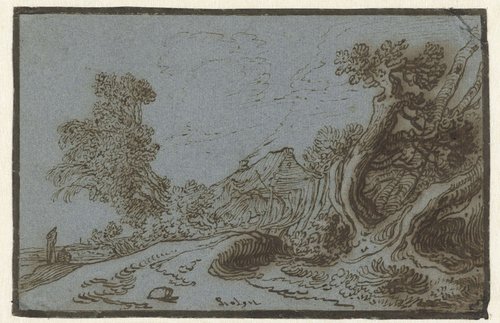
Weg tussen bomen bij een boerderij
1625 - 1629
Medium
pen
Dimensions
123; 189
Rights
Public Domain
About this artwork
height 123 mm x width 189 mm
Art Historical Context
**Weg tussen bomen bij eenerderij** (Path between Trees near a Farm), a delicate pen drawing by Dutch artist Pieter de Molijn, dates to around 1625-1629. Measuring just 123 mm high by 189 mm wide, intimate sketch captures a serene rural scene: a winding path flanked by trees leading toward a modest farm. De Molijn, active in Haarlem during the Dutch Golden Age, was a pioneer in landscape art, blending everyday countryside motifs with atmospheric depth. Created during the early 17th century, when the Netherlands flourished economically and culturally, the work reflects the rising popularity of landscape as an independent genre. Influenced by contemporaries like Jan van Goyen and Esaias van de Velde, de Molijn's style emphasized tonal subtlety and natural light, moving away from idealized Renaissance views toward realistic depictions of the Dutch polder landscape. Pen drawings like this served as studies for larger oil paintings, showcasing his mastery of line and form. The modest scale and monochrome medium highlight de Molijn's skill in evoking mood through economical strokes—hatching for shadows, fluid lines for foliage. As a snapshot of rural tranquility, it invites viewers to appreciate the humble beauty that inspired the Golden Age masters, reminding us of the era's fascination with the familiar home turf.
About the Artist
Pieter de Molijn · 1595–1661
**Pieter de Molijn** (1595–1661) was a Dutch Golden Age landscape painter of English birth and Flemish descent, baptized on 6 April 1595 in London at the Dutch Reformed Austin Friars church to parents from Ghent and Brussels. His family likely emigrated to England for economic opportunities, but young Pieter returned to the Netherlands, settling in Haarlem where he joined the Guild of St. Luke in ...