
Wenlock Abbey
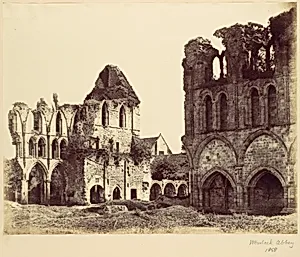
Medium
Albumen silver print from paper negative
Dimensions
21.4 x 27.2 cm. (8 7/16 x 10 11/16 in.)
Classification
Photographs
Department
Photographs
Museum
Metropolitan Museum of Art, New York, NY
Credit
Gift of Paul F. Walter, in memory of Christopher Hemphill, 1987
Accession Number
1987.1183.44
Rights
Public Domain
Tags
Art Historical Context
Alfred Capel Cure's *Wenlock Abbey* (1858) captures the evocative ruins of the medieval Cistercian abbey inropshire, England, a site founded in the 12th and largely destroyed during Henry VIII's Dissolution of the Monasteries in the 1530s. This albumen silver print from a negative reflects the mid-19th-century fascination with Gothic architecture and picturesque decay, as photographers like Cure documented Britain's historic landmarks amid the rise of antiquarian interest and the Gothic Revival movement. Printed using the calotype process—invented by William Henry Fox Talbot in the 1840s—the image employs a paper negative to produce a detailed, textured positive with subtle tonal gradations. At 21.4 x 27.2 cm, its intimate scale invites close contemplation of weathered stone arches and fragmented walls, highlighting photography's emerging role as a precise tool for architectural preservation before widespread glass-plate techniques took hold. Now in the Metropolitan Museum of Art's Photographs Department (gift of Paul F. Walter, 1987), this work exemplifies early photographic artistry, blending technical innovation with romantic reverence for the past. Cure, an amateur photographer and clergyman, specialized in such architectural studies, offering visitors a timeless window into England's monastic heritage.
About the Artist
Alfred Capel Cure · 1826–1896
Alfred Capel Cure (1826–1896) was a British artist whose career unfolded during the Victorian era, a period of remarkable diversity and ambition in British art. Active in a landscape tradition shaped by the achievements of John Constable and J.M.W. Turner, Cure worked at a time when watercolor and drawing held an especially prominent place in English artistic culture, embraced both by professional...