
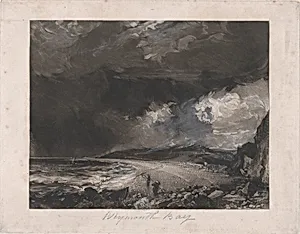
Weymouth Bay
Medium
Mezzotint touched with white chalk; proof before published state
Dimensions
Image: 5 5/8 × 7 3/16 in. (14.3 × 18.3 cm) Plate: 6 15/16 × 8 15/16 in. (17.6 × 22.7 cm) Sheet: 8 3/4 × 13 1/8 in. (22.2 × 33.3 cm)
Classification
Prints
Department
Drawings and Prints
Museum
Metropolitan Museum of Art, New York, NY
Credit
Harris Brisbane Dick Fund, 1927
Accession Number
27.4.25
Rights
Public Domain
Tags
Art Historical Context
**Weymouth Bay**, a captivating mezzotint proof from 1830, the masterful collaboration between English Romantic painter John Constable and engraver David Lucas. Constable, renowned for his luminous landscapes capturing the transient beauty of nature, provided the original composition of this stormy seascape at Weymouth Bay on England's Dorset coast. Lucas translated it into print, with subtle touches of white chalk adding glowing highlights to the turbulent waves and brooding skies—evident in this pre-publication proof state, offering a rare glimpse into the creative process. Mezzotint, a technique pioneered in the 17th century, excels at producing velvety blacks and soft gradations, making it ideal for Constable's atmospheric effects. Here, it evokes the drama of a storm-tossed sea, blending realism with Romantic emotion to convey nature's sublime power. This work was part of their ambitious *English Landscapes* series, which democratized Constable's oil sketches through affordable prints, bridging fine art and popular appreciation during the early 19th century. Housed in the Metropolitan Museum of Art's Drawings and Prints department (Harris Brisbane Dick Fund, 1927), *Weymouth Bay* highlights printmaking's role in preserving ephemeral sketches. Visitors are drawn to its moody intensity, a testament to how Constable's fresh vision of Britain's coastlines continues to stir wonder. (198 words)
About the Artist
David Lucas|John Constable · 1802–1881
**David Lucas (1802–1881)** David Lucas was born in 1802 in Geddington Chase, Northamptonshire, the son of a farmer.) A chance encounter in 1820 led him to become a pupil of the renowned engraver Samuel William Reynolds, under whom he apprenticed in London until 1827, mastering the art of mezzotint engraving.) By 1827, Lucas had published his first mezzotints, showcasing his precocious talent for...