
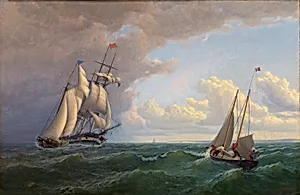
Whaler off the Vineyard--Outward Bound
1859
Medium
Painting
Classification
Painting
Department
Smithsonian Collection
Museum
Smithsonian American Art Museum
Credit
Smithsonian American Art Museum, Museum purchase
Accession Number
1978.72
Rights
Public Domain
Tags
About this artwork
William Bradford is best known for his paintings of the Arctic, but his early work focused on the ships of New England. He grew up near New Bedford, Massachusetts, which was home to a successful whaling industry. In this image, he painted a large whaling ship with a smaller schooner sailing in the foreground, and the cliffs of Gay Head, Martha's Vineyard, in the background. This area was the standard route for whalers entering and leaving the port of New Bedford. Bradford emphasized the smallest...
Art Historical Context
William Bradford, best known today for his dramatic Arctic seascapes, began his career capturing the bustling maritime world of his native New England. Growing up near New Bedford, Massachusetts—a thriving center of the 19th-century whaling industry—he turned his attention to the ships that defined the region’s economy and identity. Painted in 1859, *Whaler off the Vineyard—Outward Bound* shows a large whaling vessel making its way past the distinctive cliffs of Gay Head on Martha’s Vineyard, a familiar landmark for sailors leaving or returning to port. The composition places a smaller schooner in the foreground, guiding the viewer’s eye toward the majestic whaler under full sail. Bradford’s meticulous attention to detail—visible in the ripples across the canvas sails and the simple suspenders worn by the crew—reveals his commitment to accuracy and his deep familiarity with life at sea. As a painting, the work invites close looking, rewarding viewers who linger on its carefully rendered textures and expansive ocean vista. This early canvas offers a window into America’s whaling heritage and Bradford’s development as an artist who would later become celebrated for his polar expeditions. Today it resides in the Smithsonian American Art Museum, preserving both a specific moment in maritime history and the quiet grandeur of 19th-century shipboard life.