
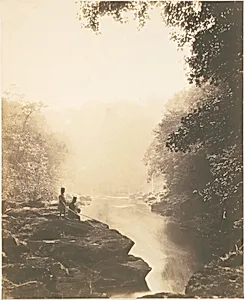
Wharfe and Pool, Below the Strid
1854
Medium
Salted paper print
Dimensions
Image: 34.5 x 28.2 cm (13 9/16 x 11 1/8 in.) Mount: 56.8 x 44.9 cm (22 3/8 x 17 11/16 in.)
Classification
Photographs
Department
Photographs
Museum
Metropolitan Museum of Art, New York, NY
Credit
Gilman Collection, Purchase, W. Bruce and Delaney H. Lundberg Gift, 2005
Accession Number
2005.100.8
Rights
Public Domain
Tags
Art Historical Context
**Wharfe and Pool, Below the Strid** (1854) is a serene salted paper print by Roger Fenton, a pioneering British best known for his groundbreaking Crimean War images. Captured along the River Wharfe Yorkshire's dramatic Strid gorge, the photograph depicts a tranquil pool with two men fishing amid lush, rocky landscapes. Fenton's composition masterfully balances the river's gentle flow with the rugged natural surroundings, inviting viewers into a peaceful English countryside scene. This work exemplifies early photography's salted paper process, a technique from the 1840s–60s that produced soft, warm tones and rich detail on paper sensitized with salt and silver nitrate. At 34.5 x 28.2 cm, the image—mounted larger for display—showcases Fenton's skill in harnessing sunlight to evoke depth and atmosphere, bridging painting's pictorial traditions with photography's precision. Part of the Metropolitan Museum of Art's Gilman Collection, this print highlights photography's rapid evolution in the mid-19th century, when artists like Fenton elevated landscapes from mere documentation to artistic expression. It captures Victorian-era leisure—fishing as communion with nature—reminding us how early photographers romanticized Britain's wild beauty. (198 words)
About the Artist
Roger Fenton · 1819–1819
Roger Fenton (1819–1869), born into a prosperous Lancashire merchant family as the son of banker and MP John Fenton, initially pursued a scholarly path, earning a first-class BA from the University of London in 1840 before studying law at University College London. He abandoned these pursuits for art, training as a painter under the history painter Charles Lucy in London by 1847—the two became clo...