
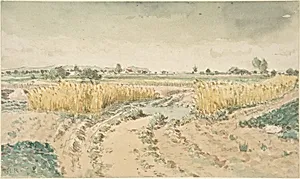
Wheatfields
Medium
Watercolor, over black chalk
Dimensions
3 11/16 x 6 1/4 in. (9.4 x 15.9 cm)
Classification
Drawings
Department
Drawings and Prints
Museum
Metropolitan Museum of Art, New York, NY
Credit
Rogers Fund, 1967
Accession Number
67.170
Rights
Public Domain
Tags
Art Historical Context
Théodore Rousseau’s *Wheatfields* (1865) offers an intimate glimpse of rural France through the eyes of one of the leading figures of the Barbizon School Rejecting the idealized landscapes of academic tradition, Rousseau and his circle championed direct observation of nature, often working outdoors to capture the quiet poetry of the countryside. This small watercolor, measuring just under four by six-and-a-quarter inches, distills that philosophy into a modest yet evocative study of agricultural life. Executed in watercolor over black chalk, the drawing demonstrates Rousseau’s sensitive handling of light and texture. The medium allows luminous washes to suggest rippling fields while the underlying chalk provides subtle structure, evoking both the golden abundance of harvest time and the vast, open sky above. Such works reflect the nineteenth-century fascination with the rhythms of farming and the dignity of peasant labor, themes that resonated deeply during a period of rapid industrialization. Acquired by the Metropolitan Museum of Art through the Rogers Fund in 1967, *Wheatfields* remains a cherished example of how Rousseau transformed ordinary landscapes into profound meditations on humanity’s relationship with the land.
About the Artist
Théodore Rousseau · 1812–1867
Théodore Rousseau (1812–1867) was a French landscape painter and the leading figure of the Barbizon School, the group of artists who settled in the village of Barbizon near the Forest of Fontainebleau to paint directly from nature. Born in Paris, he showed precocious talent and studied under the academic painters Charles Rémond and Guillaume Guillon-Lethière, but quickly rejected classical landsca...