
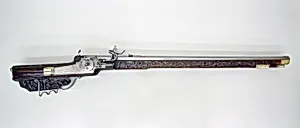
Wheellock Rifle
ca. 1663
Medium
Steel, wood (walnut), brass, bone
Dimensions
L. 40 3/4 in. (103.5 cm); L. of barrel 29 3/4 in. (75.6 cm); Cal. .52 in. (13.2 mm); Wt. 7 lb. 12 oz. (3515.3 g)
Classification
Firearms-Guns-Wheellock
Culture
German, Gmünd
Department
Arms and Armor
Museum
Metropolitan Museum of Art, New York, NY
Credit
Gift of the Estate of James Hazen Hyde, 1959
Accession Number
59.208.84
Rights
Public Domain
Art Historical Context
Step into the intricate world of17th-century German firearms this stunning wheellock crafted by Lienhart Has 1663. Housed the Metropolitan Museum of's Arms and Armor Department, this piece measures an impressive 40¾ inches long, with a 29¾-inch steel barrel of .52 caliber, weighing just over 7½ pounds. Its walnut stock is elegantly adorned with brass and bone inlays, showcasing the gunsmith's mastery in blending with decorative artistry—a hallmark of luxury weapons from Gmünd, a renowned center German gunmaking. The wheellock mechanism a technological marvel of its era, invented in the early 150s and perfected in regions like southern Germany. By spinning a spring-loaded wheel against a piece of pyrite, it produced sparks to ignite the priming powder, allowing reliable firing without the lit match required by earlier hand cannons. Though flintlocks were emerging by the 1660s, wheellocks like this persisted among elite hunters and soldiers for their precision and weather resistance. This rifle, a gift from the Estate of James Hazen Hyde in 1959, exemplifies the cultural prestige of arms as both tools of war and status symbols. Its meticulous construction highlights the fusion of engineering ingenuity and ornamental skill, offering visitors a tangible glimpse into Europe's transformative age of gunpowder innovation.