
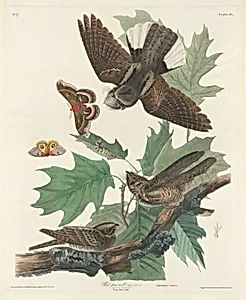
Whip-poor-will
Medium
hand-colored engraving and aquatint on Whatman wove paper
Dimensions
plate: 65.2 x 52.5 cm (25 11/16 x 20 11/16 in.) sheet: 99.7 x 67 cm (39 1/4 x 26 3/8 in.)
Classification
Department
CG-W
Museum
National Gallery of Art, Washington, D.C.
Credit
Gift of Mrs. Walter B. James
Accession Number
1945.8.82
Rights
Public Domain
Art Historical Context
Behold the enchanting *Whip-poor-will*, a hand-colored engraving and aquat by Robert Havell after John James Audubon, in 1830. This print captures the nocturnal Whip-poor-will—a bird famed for its haunting, repetitive call that echoes through moonlit forests—in a strikingly lifelike pose amid its natural habitat. Part of Audubon's monumental *Birds of America series, it exemplifies the artist's pioneering mission to document every known North American bird species at actual size, revolutionizing ornithological illustration during the early 19th century. Havell's masterful technique shines through the aquatint process, which allowed for soft, tonal gradations mimicking feathers' subtle textures, enhanced by meticulous hand-coloring on high-quality Whatman wove paper. Measuring an impressive plate size of 65.2 x 52.5 cm, these "double elephant" folios were produced in London to reach elite subscribers, blending scientific precision with artistic drama. Audubon's dynamic compositions, where birds interact with their environment, broke from static taxidermy-style illustrations, influencing wildlife art for generations. Today, housed in the National Gallery of Art as a gift from Mrs. Walter B. James, this print not only celebrates American biodiversity but also Audubon's adventurous life—from self-taught artist to frontier explorer—inviting visitors to ponder the wild symphony of nature preserved in vivid color.
About the Artist
Robert Havell after John James Audubon
Robert Havell Jr., born on November 25, 1793, in Reading, Berkshire, England, was the son of renowned engraver and publisher Robert Havell Sr. and Lydia Miller Phillips. Growing up in a family of artists that included notable engravers and etchers, he trained under his father, mastering aquatint techniques early on. Though briefly estranged from the family business, Havell reconciled with his fath...