
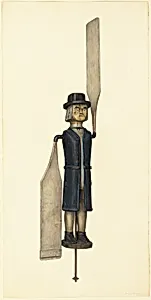
Whirligig
c. 1941
Medium
watercolor, graphite, colored pencil and scraping, and pen and ink on paperboard
Dimensions
overall: 71.9 x 35.6 cm (28 5/16 x 14 in.) Original IAD Object: 29 3/4" high
Classification
Index of American Design
Department
CG-W
Museum
National Gallery of Art, Washington, D.C.
Credit
Index of American Design
Accession Number
1943.8.7766
Rights
Public Domain
Art Historical Context
**Whirligig** *Mina Lowry, c. 1941* Watercolor, graphite, colored pencil and scraping, and pen and ink on paperboard, 71.9 × 35.6 cm (28 5/16 × 14 in.) *Index of American Design, National Gallery of Art* Step into the whimsical world of American folk art with Mina Lowry's *Whirligig*, a meticulous rendering created around 1941 as part of the Index of American Design (IAD). This ambitious Federal Art Project, launched under the Works Progress Administration during the Great Depression, employed artists to document everyday objects of American craftsmanship through detailed watercolor studies. Lowry's work preserves a classic whirligig—a wind-powered folk sculpture beloved for its playful motion and rustic charm—ensuring these vernacular treasures endure for future generations. Lowry masterfully layered watercolor for vibrant hues, graphite and colored pencil for fine details, innovative scraping techniques for textured effects, and pen and ink for sharp outlines, all on sturdy paperboard. This multi-medium approach on a substantial 28 5/16 × 14-inch sheet captures the whirligig's intricate forms with documentary precision, blending artistic flair with scientific accuracy. Housed in the National Gallery of Art's collection, it exemplifies the IAD's role in elevating folk art as a vital thread in America's cultural tapestry. Today, *Whirligig* invites us to appreciate the ingenuity of anonymous makers and the artists like Lowry who immortalized them, reminding visitors of our shared heritage of creativity amid adversity.
About the Artist
Mina Lowry · 1894–1942
Mina Lowry (1894–1942), an American artist born in Canada, emerged as a prominent portrait painter whose career bridged traditional portraiture and the documentation of American folk art. Immigrating to Buffalo, New York, with her family around 1901, she honed her skills early on, winning first prize for modeling at the Albright Art School and studying under the esteemed Florence J. Bach. Lowry fu...