
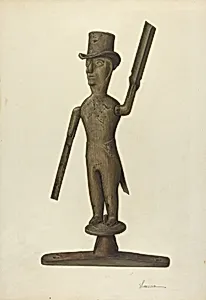
Whirligig
c. 1939
Medium
watercolor and graphite on paperboard
Dimensions
overall: 48 x 33.5 cm (18 7/8 x 13 3/16 in.) Original IAD Object: 18 1/4" high
Classification
Index of American Design
Department
CG-W
Museum
National Gallery of Art, Washington, D.C.
Credit
Index of American Design
Accession Number
1943.8.16306
Rights
Public Domain
Art Historical Context
**Whirligig** by Selma Sandler, created around 1939, is a captivating watercolor and graphite rendering on paperboard from the Index of American Design (IAD). This ambitious WPA Federal Art Project, launched during the Great Depression, employed artists across the U.S. to meticulously document everyday examples of American folk art and. Sandler's precise depiction preserves a traditional whirligig—a, wind-powered wooden toy or garden ornament featuring spinning figures, emblematic of rural ingenuity and19th-century vernacular design. Measuring 48 x 33.5 cm overall, it faithfully scales the original object at about 18 1/4 inches high, now housed in the National Gallery of Art. Sandler's technique blends soft watercolor washes for vibrant textures with graphite for sharp outlines, highlighting the whirligig's carved details, dynamic motion, and playful form. This medium was ideal for the IAD's goal of creating an accessible "visual encyclopedia" of America's cultural heritage, blending artistic skill with documentary accuracy. Today, this work underscores the IAD's enduring legacy in celebrating folk traditions amid economic hardship, reminding us of the creativity embedded in everyday American life. A delightful window into our shared past! (198 words)
About the Artist
Selma Sandler · 1917–2005
Selma Sandler (1917–2005) was an American artist whose meticulous watercolor renderings played a vital role in documenting the nation's folk art heritage during the Great Depression. Born on March 18, 1917, she contributed to the Index of American Design, a Works Progress Administration (WPA) project under the Federal Art Project that ran from 1935 to 1942. This ambitious endeavor employed artists...