
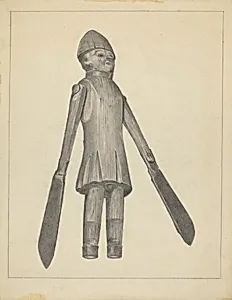
Whirligig
c. 1937
Medium
graphite on paperboard
Dimensions
overall: 29.3 x 23 cm (11 9/16 x 9 1/16 in.) Original IAD Object: 12 1/2" high
Classification
Index of American Design
Department
CG-W
Museum
National Gallery of Art, Washington, D.C.
Credit
Index of American Design
Accession Number
1943.8.16272
Rights
Public Domain
Art Historical Context
**Whirligig** *Joseph Stonefield, c. 1937* Graphite on paperboard, 29.3 × 23 cm (11 9/16 × 9 1/16 in.) *Index of American Design, National Gallery of Art* This delicate graphite drawing captures the whimsical charm of a classic American whirligig, a folk art toy measuring 12½ inches high, designed to spin merrily in the breeze. Created by artist Joseph Stonefield around 1937, the work showcases meticulous line work on paperboard, highlighting the object's carved wooden form, dynamic blades, and playful details that evoke rural American ingenuity from the 19th and early 20th centuries. As part of the *Index of American Design*—a landmark WPA Federal Art Project (1935–1942)—Stonefield's rendering preserves everyday folk objects amid the Great Depression. This initiative employed artists to document vanishing American crafts through precise, measured drawings, ensuring cultural heritage endured. Whirligigs, often patriotic or fantastical figures, symbolized joyful self-expression and were treasured lawn ornaments or children's playthings. Stonefield's technique emphasizes accuracy and texture, rendering the whirligig's contours and motion with fine graphite strokes. Today, it invites visitors to appreciate how folk art bridged utility and fantasy, reflecting America's vibrant vernacular traditions.