
Whirligig
1935/1942
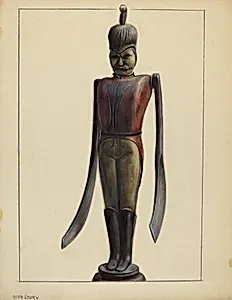
Medium
watercolor, pen and ink, gouache, and graphite on paperboard
Dimensions
overall: 28.8 x 22.3 cm (11 5/16 x 8 3/4 in.) Original IAD Object: 26 3/4" high
Classification
Index of American Design
Department
CG-W
Museum
National Gallery of Art, Washington, D.C.
Credit
Index of American Design
Accession Number
1943.8.16273
Rights
Public Domain
Art Historical Context
**Whirligig** *By Mina Lowry, 193/1942* *Watercolor, pen and ink, gouache, and graphite on paperboard**28.8 × 22.3 cm (11 5/16 × 8 3/4 in.), National Gallery of Art, of American Design* Created by artist Mina Lowry, *Whirligig* is a meticulous rendering of a classic American art wind toy, originally standing 26 3/4 inches high. whimsical whirligigs—often carved wooden figures of soldiers, animals, or farmers that spin and gesture in the breeze—embody the playful ingenuity of rural American craftsmanship from the 18th and 19th centuries. Lowry's depiction captures the object's lively motion and hand-hewn charm, preserving a slice of everyday Americana that might otherwise fade from memory. This artwork emerged from the Index of American Design, a groundbreaking Federal Art Project under the Works Progress Administration (WPA) from 1935 to 1942. During the Great Depression, over 200 artists documented thousands of folk art objects through precise, colorful renderings, celebrating the nation's diverse cultural heritage. Lowry's use of watercolor, pen and ink, gouache, and graphite on paperboard allowed for vivid details, subtle shading, and a sense of three-dimensionality, blending technical accuracy with artistic flair. Displayed in the National Gallery of Art, *Whirligig* highlights how folk traditions influenced American identity, inviting us to appreciate the creativity of ordinary makers in an extraordinary time.
About the Artist
Mina Lowry · 1894–1942
Mina Lowry (1894–1942), an American artist born in Canada, emerged as a prominent portrait painter whose career bridged traditional portraiture and the documentation of American folk art. Immigrating to Buffalo, New York, with her family around 1901, she honed her skills early on, winning first prize for modeling at the Albright Art School and studying under the esteemed Florence J. Bach. Lowry fu...