
White Headed Eagle (Haliaetus leucocephalus)
published 1832-1837
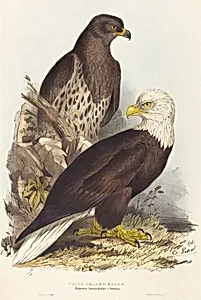
Medium
hand-colored lithograph on wove paper
Dimensions
sheet: 54 x 36 cm (21 1/4 x 14 3/16 in.)
Classification
Department
CG-E
Museum
National Gallery of Art, Washington, D.C.
Credit
Collection of Dr. and Mrs. George Benjamin Green
Accession Number
1991.163.60
Rights
Public Domain
Art Historical Context
In this hand-colored lithograph, two eagles occupy a spare natural setting. The foreground features a bald eagle with a crisp white head and tail, dark brown body, and bright yellow beak and talons gripping the ground. Behind it, a second eagle with mottled brown-and-white plumage perches on a rocky outcrop, its head turned slightly toward the viewer. Delicate shading and precise coloring define each feather, while faint foliage and earth tones anchor the birds against a pale background. Edward Lear created the image for publication between 1832 and 1837. Titled White Headed Eagle (Haliaetus leucocephalus), the print demonstrates the careful observation and technical skill that marked early nineteenth-century ornithological illustration. Such works helped naturalists and the public alike study avian species through accurate, large-scale reproductions on wove paper.
About the Artist
Edward Lear · 1812–1888
Edward Lear (1812–1888) was a British artist, illustrator, author, and poet whose creative output ranged from meticulous natural history illustration to landscape painting and the beloved comic verse of his limericks and nonsense poetry. Born in London as the twentieth of twenty-one children, Lear largely educated himself as a draughtsman and began his professional career illustrating parrots for ...