
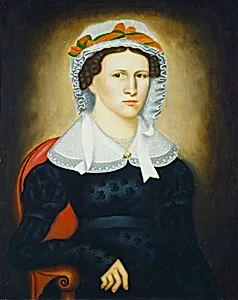
Wife of Man with Vial
c. 1827
Medium
oil on canvas
Dimensions
overall: 75 x 60 cm (29 1/2 x 23 5/8 in.) framed: 96.8 x 81.6 x 7.6 cm (38 1/8 x 32 1/8 x 3 in.)
Classification
Painting
Department
CAB
Museum
National Gallery of Art, Washington, D.C.
Credit
Gift of Edgar William and Bernice Chrysler Garbisch
Accession Number
1955.11.20
Rights
Public Domain
Art Historical Context
Erastus Salisbury Field’s “Wife of Man with Vial” captures the quiet dignity of early American portraiture. Painted around 1827 in oil on canvas, the belongs to a tradition of paired husband-and-wife likenesses that rural families commissioned before photography became widespread. Field, a largely self-taught artist from Massachusetts, traveled from town to town creating affordable, forthright images that emphasized clothing, posture, and personal attributes over elaborate settings. The modest scale and direct gaze invite viewers to imagine the sitter’s daily life in nineteenth-century New England. The unusual title suggests the portrait once hung beside an image of her husband holding a small glass vial—an object that may have held personal or professional meaning. Such details reveal how folk artists wove individual stories into the broader narrative of American identity. Today the painting stands as a cherished example of vernacular art, preserved through the generosity of collectors Edgar William and Bernice Chrysler Garbisch and now part of the National Gallery of Art’s collection. Its unpretentious charm continues to connect modern audiences with the people who helped shape a young nation.
About the Artist
Erastus Salisbury Field · 1805–1900
1805–1900