
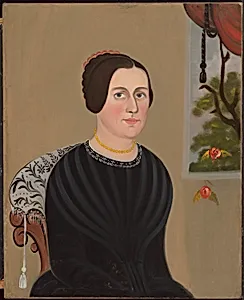
Woman with Gold Necklace
ca. 1850
Medium
Painting
Classification
Painting
Department
Smithsonian Collection
Museum
Smithsonian American Art Museum
Credit
Smithsonian American Art Museum, Gift of Herbert Waide Hemphill, Jr. and museum purchase made possible by Ralph Cross Johnson
Accession Number
1986.65.134
Rights
Public Domain
Tags
About this artwork
Woman with Gold Necklace combines the Prior-Hamblin School’s enthusiasm for portraiture, ornamental painting, and landscape scenery. Aside from a lively business in portraiture, William Matthew Prior painted several landscape scenes, which he referred to as “fancy pieces,” a term used in the late eighteenth and early nineteenth century to describe a variety of arts such as decorative painting, knitting, and quilting. His advertisements boasted that he worked “in a very tasty style.” (Vlach, Plai...
Art Historical Context
**Woman with Gold Neckl** *Prior-Hamblen School, ca. 1850* Oil on canvas Smithsonian American Art Museum, Gift of Herbert Waide Hemphill, Jr. and museum purchase made possible by Cross Johnson Step into the world of 19th-century folk art with *Woman with Gold Neckl*, a charming waist-length portrait from the Prior-Hen School. This collaborative style, led by painters William Matthew Prior and Sturte J. Hamblin, in New England around 1840–1860. They were itinerant artists who catered to middle-class families, producing affordable, stylized portraits that captured everyday sitters with a distinctive flatness and vibrancy. Here, the woman is adorned with a prominent gold necklace—highlighting her status—set against ornamental elements, a window, and hints of landscape scenery, blending portraiture with decorative flair. The Prior-Hamblen School's enthusiasm for "fancy pieces" shines through, a term from the late 18th and early 19th centuries for whimsical arts like ornamental painting and textiles. Prior himself advertised his landscapes and portraits as executed "in a very tasty style," emphasizing bold patterns and lively scenery over realism. This painting exemplifies folk art's democratic appeal: accessible commissions that brought beauty and personalization into modest homes, preserving personal stories amid America's growing middle class. As part of the Smithsonian American Art Museum's collection, it invites us to appreciate how these "plain painters" democratized art, turning simple canvases into treasured family heirlooms. (198 words)