
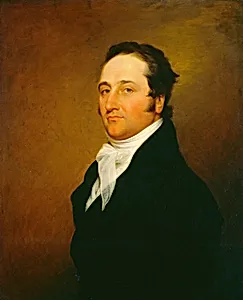
William Rogers
1804/1808
Medium
oil on canvas
Dimensions
overall: 77.5 x 63.5 cm (30 1/2 x 25 in.) framed: 101.6 x 88.9 x 6.4 cm (40 x 35 x 2 1/2 in.)
Classification
Painting
Department
CAB
Museum
National Gallery of Art, Washington, D.C.
Credit
Andrew W. Mellon Collection
Accession Number
1947.17.13
Rights
Public Domain
Art Historical Context
John Trumbull’s *William Rogers* (1804/1808) captures the dignified presence of its sitter through the refined traditions of early American portraiture. Trumbull, celebrated for his monumental scenes of the Revolutionary War, also produced numerous individual portraits that helped shape the visual identity of the new nation. This oil-on-canvas work, measuring roughly 30 by 25 inches, exemplifies the intimate scale he often chose for private commissions, allowing viewers a direct encounter with the subject. Painted during the first decade of the nineteenth century, the portrait reflects a period when American artists sought to balance European academic training with a distinctly national sensibility. Trumbull’s careful modeling of form and restrained palette convey both realism and quiet authority, qualities that made his likenesses prized records of early republican society. The painting’s presence in the National Gallery of Art’s Andrew W. Mellon Collection underscores its enduring value as both a historical document and a fine example of Federal-era portraiture.
About the Artist
John Trumbull · 1756–1843
John Trumbull, born on June 6, 1756, in Lebanon, Connecticut, to prominent Puritan descendants, grew up in a politically influential family as the son of Jonathan Trumbull, Connecticut's governor from 1769 to 1784, and Faith Robinson Trumbull. His brothers included Joseph, the Continental Army's first commissary general, and Jonathan Jr., Speaker of the U.S. House of Representatives. A childhood a...