
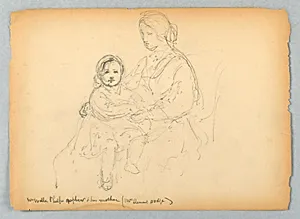
William Walter Phelps' Nephew and His Mother, Mrs. Steuart Dodge
Classification
figures
Department
Smithsonian Collection
Museum
Smithsonian American Art Museum
Credit
Bequest of Erskine Hewitt
Accession Number
1942-50-433
Rights
Public Domain
About this artwork
Research in Progress
Art Historical Context
Daniel Huntington's *William Walter Phelps' Nephew and Mother, Mrs. Ste Dodge* (1872) captures an intimate portrait of a young boy and his mother from one of 19th-century America's prominent families. Huntington, a leading American artist (1816–1906) and president of the National Academy Design, was renowned for realistic portrayals of the elite, blending the refined techniques of academic portraiture with subtle emotional depth. This work exemplifies his skill in rendering figures with lifelike poise, highlighting familial bonds amid the Gilded Age's social ascent. Created during a period of post-Civil War prosperity, the painting reflects the era's emphasis on family legacy and status among New York's industrial and political circles—Phelps himself was a notable Congressman and businessman. Though the medium remains unidentified amid ongoing research, its classification as a "figures" piece underscores Huntington's focus on human subjects, often commissioned to commemorate personal milestones. Now part of the Smithsonian American Art Museum's collection through the bequest of collector Erskine Hewitt, this artwork offers a window into Victorian domesticity and the enduring value of portraiture in preserving elite histories. Visitors can appreciate how such pieces immortalized everyday tenderness within lives of influence.