
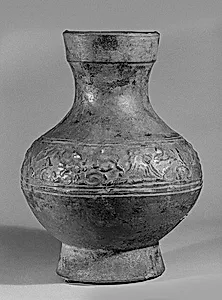
Wine container (hu)
Unknown Artist
1st–2nd century
Medium
Earthenware with lead green glaze
Dimensions
H. 15 1/8 in. (38.4 cm); Gr. Diam. 11 1/2 in. (29.2 cm)
Classification
Ceramics
Culture & Period
China · Eastern Han dynasty (25–220)
Department
Asian Art
Museum
Metropolitan Museum of Art, New York, NY
Credit
Gift of Paul E. Manheim, 1967
Accession Number
67.43.17
Rights
Public Domain
Art Historical Context
This elegant wine container, known as a *hu*, hails from China's Eastern Han dynasty (25220 CE), a golden age of innovation and cultural flourishing. Dating to the 1st–2nd, it stands 15 1/8 inches tall a generous 11 1/2-inch diameter, its pear-shaped body and narrow neck designed for storing and pouring wine—a staple of elite banquets and rituals. Crafted by an unknown artisan, such vessels were everyday luxuries, often unearthed from tombs, hinting at their role in both lively gatherings and afterlife provisions. The standout feature is its earthenware body coated in a vibrant lead green glaze, an early technological leap in Chinese ceramics. Han potters pioneered lead glazes around this time, firing them at lower temperatures to achieve a glossy, jewel-like sheen that mimicked costly bronzes or jade. This affordable yet sophisticated medium democratized beauty, bridging utility and artistry. In the Metropolitan Museum of Art's Asian Art collection (gift of Paul E. Manheim, 1967), this *hu* captures the Han era's blend of practicality and refinement, reflecting a society where even wine vessels embodied harmony and prosperity. Visitors, imagine toasting with ancients under lantern light!